In one week, Effingham County commissioners will determine whether to back Effingham Hospital’s modernization and expansion plans, using a federal loan.
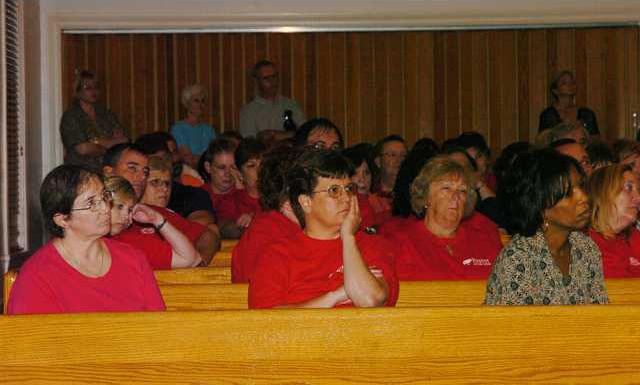
In a meeting that lasted one hour, 45 minutes Tuesday night — with a packed room filled largely with red shirt-clad hospital employees and supporters — commissioners went over the feasibility study conducted by accounting firm Dixon Hughes on the hospital’s plans and also a study from the Georgia Southern University Bureau of Business Research and Economic Development.
Hospital Authority Chairman Rick Rafter said the hospital’s long-term goal is to be able to give money back to the county.
“If we don’t have the support from the county,” he warned, “the hospital will close.”
Rafter said the hospital authority’s application for the Build America bonds is almost complete.
“We’ve got all the major pieces done,” he said. “The one thing we don’t have is the backing of the county commission.”
The hospital authority, in seeking Housing and Urban Development Build America bonds for its $31.7 million project, needs the commissioners to approve a resolution guaranteeing 2 mills in property tax for 25 years. It also is asking for about 3.8 acres of county land for the additional 58,000 square feet of hospital space.
County commissioners, however, have been circumspect about the financing plans.
“That’s $117 million for a $31 million project,” Commissioner Myra Lewis said of the millage rate request.
GSU’s Bureau of Business Research and Economic Development conducted an economic analysis and reviewed the Dixon Hughes feasibility study. It also used the regional economic model to assess the project’s impact on jobs and growth.
“The forecasts are reasonable, the assumptions are reasonable, and the financing and the project are feasible,” said Rich Rollins of Dixon Hughes.
The Georgia Southern team looked at three options — reducing and eventually eliminating the millage rate, maintaining the status quo without expansion and capping property tax support at 2 mills and going ahead with expansion. The study looked at what might happen in four years and under the first option, there would be a net job loss of 283 and real personal income would fall by more than $7 million.
The status quo option would lead to 35 new jobs by 2014 and gains of $1.2 million in real personal income and $1 million in real disposable income for the county, according to the study.
Under the hospital’s expansion plan, the study indicates 154 jobs would be created in 2011, mostly a result of the construction, and 71 jobs would be created by 2014. Real personal income will grow by $2.8 million and real disposable income is expected to grow by $2.5 million.
The Georgia Southern report called the hospital “a critical infrastructure element to attract new residents and businesses” and also said the project would not effect the county’s debt capacity. The spike in construction jobs, GSU’s Ed Sibbald said, also would serve as a bridge to what is projected to be a more robust economy in 2012-13.
Support for the hospital
Sibbald said his team strongly recommended the hospital seek the commissioners’ backing for the expansion plans. Hospital employees and supporters urged commissioners to back the hospital’s plan.
“What does a life cost?” said Jose Velasquez. “Can you put money on that? What does a child cost?”
Velasquez also wondered what would happen to someone having a heart attack or hurt in an accident if there was no hospital.
“Yes, it may cost a little more money and you might be on the hook a little longer. But what does a life cost?” he said. “I know it’s a hard decision. But look at all of it.”
Said Lucy Powell: “I have worked with a group of people greatly dependent on a hospital. Without a hospital in our area, some people would not have received any type of health care. We greatly need it.”
Brenda Lovett also called upon the commissioners to support the 2 mills for the expansion and modernization efforts. With the county’s continued growth, she said, the hospital is needed.
“We are very proud to hear we are one of the fastest growing counties in the state,” she said. “But what are we going to do to meet those needs?”
Ruth Lee said day surgery, which would generate revenue for the hospital, is the issue. She also said the planned Alzheimer’s wing at the Effingham Care Center will be vital.
“You cannot ignore the economic impact of the expansion of the hospital,” she said. “This is an economic development issue for the county, and it’s worth what it costs. The hospital needs to expand.”
Lisa Lopez addressed the commissioners and the audience, speaking, she said, on behalf of the 105 residents of the nursing home. If the hospital doesn’t receive the commissioners’ backing and closes, the nursing home also would close, and she was concerned about their futures.
“I’ve seen the care. It is not what they would receive (at Effingham Care Center),” she said.
Rollins said the 7.38 percent interest rate for the bonds is a baseline figure.
“We’re anticipating it will be lower than that,” he said.
With the 35 percent rebate of the interest on Build America bonds, the actual interest rate to the hospital will be below 5 percent, according to Rollins.
“That is the best interest rate possible,” he said. “I believe that is the best interest rate Effingham Hospital can get for the financing and the project they are proposing.”
Yet some commissioners remain skeptical.
“I am for the hospital expanding,” said Commissioner Verna Phillips. “But I think there is something better out there.”
Rafter said the hospital has explored other financing options but believes the Build America bonds — $29.6 million worth for the $31.8 million project — are the best route.
“It’s the best game in town,” he said.
Attorney Rusty Ross said the authority looked into tax exempt bonds. “Nowadays, you can’t get them if you want them,” he said. “What better loan than one guaranteed by the federal government?”
Should the hospital default on its loan payments, HUD could take over operations. But that’s not something that agency is likely to do, Rafter said.
“HUD isn’t going to let you go and flounder and die. HUD doesn’t want us to fail,” he said. “The last thing they want to do is to come in and run a hospital. They really are trying to make sure everything we’re doing makes sense and that it will succeed.”
Rollins said his firm believes the project is viable for Effingham County — but the millage support is critical.
“In our opinion, without the tax support, the project is not feasible,” he said. “The tax support is integral to this project to get it approved by HUD.”
Rafter acknowledged the initial loan payments could be high, but the hospital would get $14 million in interest rebates and the GSU study showed a $122 million growth in gross county output and $80 million in real disposable income for a county tax investment of $117 million.
A taxing situation
Some residents also objected to the dedication of 2 mills per year over the life of the 25-year loan.
“I’m taxed out. I can’t afford no more,” said Michael Stephens.
Stephens also questioned how the hospital could be profitable with a $30 million debt to pay off.
“In 40 years, there’s been a loss every year,” said former county commissioner Hubert Sapp. “The taxpayers can’t stand but so much on their backs.”
David Scott said the land in question isn’t the county’s but belongs to the taxpayers. Scott also said that while he doesn’t have a problem with the hospital, he also doesn’t use it, since he’s closer to the Savannah hospitals.
“Do I have to keep paying for it when it doesn’t show a profit?” he said. “Sometimes, when times get tight, you have to tighten up. My property taxes have gone up every year. Please, please, please think about the taxpaying residents who are going to be writing those checks. My checkbook doesn’t understand there’s no impact on the county debt capacity. My checkbook understands there is a 2 mill debt capacity every year that I have to pay and will pay, at a minimum, for the next 25 years.”
Melissa Waller said the 2 mill request isn’t a call for a tax increase, since the hospital gets close to that amount every year.
“We’re not talking about a tax increase. We’re talking about a tax allocation,” she said. “My position is, if they don’t spend those 2 mills on the hospital, are they going to give it back to us? They’re going to spend it on something else.”
The cost of uncompensated care
Rafter said the hospital isn’t asking for additional millage, just the millage needed to cover the costs of uncompensated care. Uncompensated care includes indigent patients with no means for payment and patients who can’t cover their insurance deductibles or co-payments. It also includes bad debt.
“If we took out uncompensated care, we’d be a booming business,” he said.
The loss of the hospital would mean taking the 13,000 emergency room visits and moving them to Savannah, Rafter said. That won’t be easy or cheap, he told commissioners.
“You think Chatham County is going to support our $4.5 million in uncompensated care? You’re going to get a bill, and it’s not going to be a bill at a discount,” he said. “It’s going to cost the taxpayers more in uncompensated care than to not have a hospital.”
Commissioners also have repeatedly questioned the hospital’s tab for uncompensated and indigent care.
“Would you believe that’s $86,000 a week? There’s no way,” said Commissioner Reggie Loper.
Deadline approaching
The deadline for Build America bonds is Dec. 31, and the hospital is seeking to have its application into HUD next month. Rafter said it’s about a four-month process for HUD to conduct its in-depth review of the application.
He also trumpeted the advancements in telemedicine at Effingham Hospital and its partnership in the REACH stroke treatment program.
Rafter encouraged commissioners to either support the request for 2 mills or come up with arrangement for $3.6 million a year in support.
“We’ve got a lot of plans for this hospital,” he said. “This hospital has a future than can really benefit Effingham County. To not support the hospital is the wrong thing to do.”