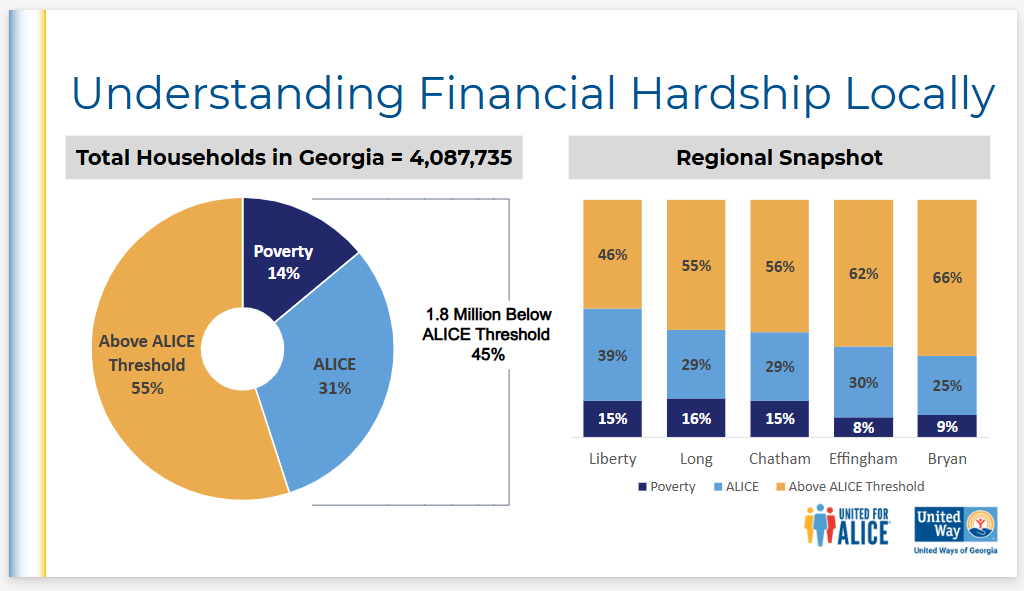
SPRINGFIELD, Ga. — Nearly 40% of Effingham County households are working but still struggling to afford basic necessities, according to new data from United Way of the Coastal Empire.
Roughly 40% of households fall below the ALICE threshold — a measure that includes both those living in poverty and those earning above it but still unable to cover the cost of living. ALICE, which stands for Asset Limited, Income Constrained, Employed, identifies households often overlooked in traditional economic data.
“These are people who are working — sometimes multiple jobs — but still can’t make ends meet,” said Leia Dedic, chief operating officer of United Way of the Coastal Empire, during a recent presentation to community leaders.
Unlike federal poverty guidelines, which do not account for regional cost differences, ALICE data reflects actual living costs in a community. In Effingham County, a single adult needs about $36,500 annually to meet basic needs, while a family of four requires roughly $84,400. These figures cover essentials such as housing, food, transportation, health care, and taxes.
Housing remains a major challenge. While the ALICE budget estimates rent at just over $1,100 per month, the average rent in Effingham County is closer to $2,100, making affordable options extremely limited. “There were virtually no rentals available at that lower price point,” Dedic said.
Impact on families and employers
ALICE households fill essential jobs in education, health care, retail, and logistics. But financial strain can affect employers: workers may leave jobs for small pay increases, miss work due to childcare or transportation issues, and struggle with productivity. “This is often not a motivation problem,” Dedic said. “It’s a barrier problem.”Certain groups are more vulnerable, including single-parent households, younger workers, and seniors. Many earn too much to qualify for public assistance but too little to achieve financial stability. “They don’t have that safety net,” Dedic said.
United Way officials said the data is already shaping local programs, including financial assistance, nonprofit partnerships, free tax preparation and counseling, and employer wage and benefit strategies. Businesses are using the data to develop flexible benefits, such as childcare or transportation support, and understand the wages needed to sustain a healthy workforce.
“ALICE data provides the insights we need to create financially successful families, productive workplaces, and a healthy economy,” Dedic said.
ALICE data is available at UnitedforALICE.org.