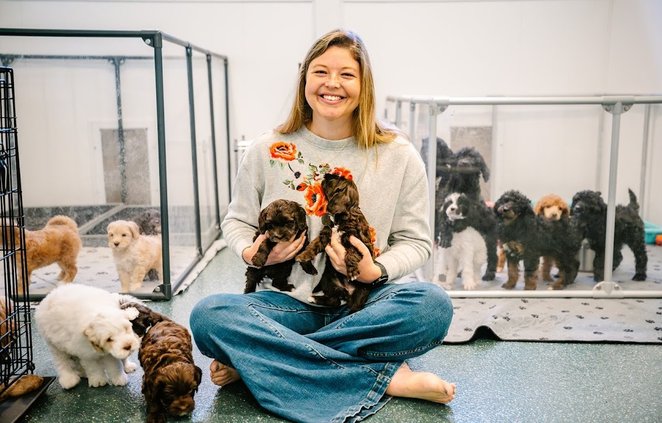
GUYTON, Ga. — By the time most teenagers are worrying about prom and college applications, Casey Weredyk was already laying the groundwork for a dog-breeding business that would shape her life — and the lives of hundreds of families — for years to come.
What began as an FFA Supervised Agricultural Experience project has grown into a full-time, purpose-driven farm and a nationally recognized dog-breeding program rooted in science and focused on producing service, therapy and well-tempered family dogs.
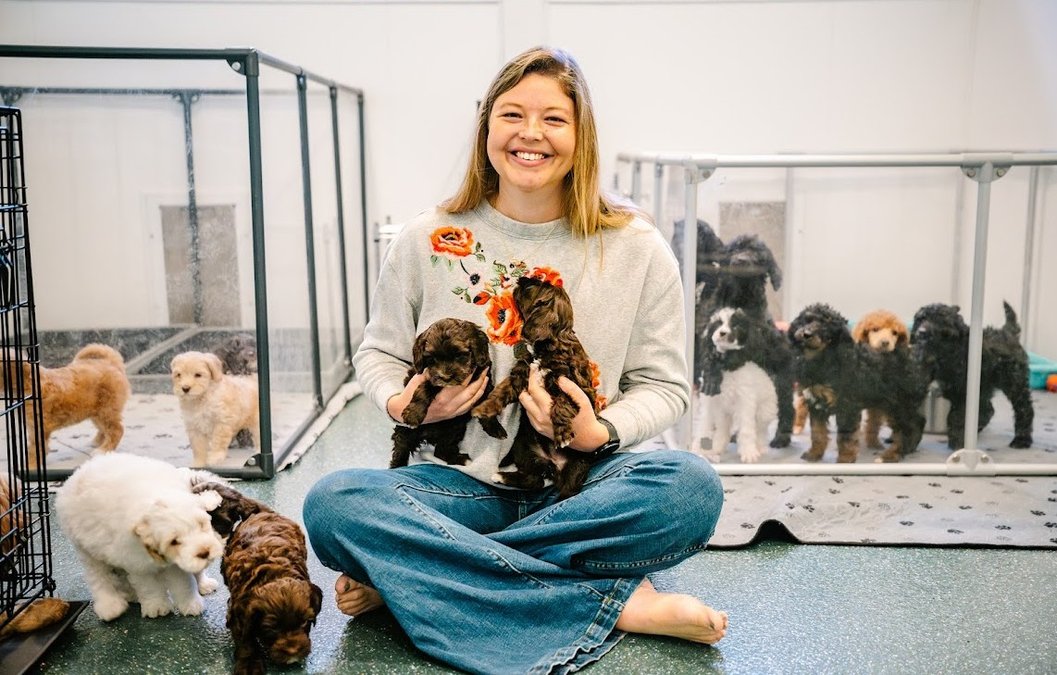
Today, Weredyk runs a science-based breeding operation named CNR Farms at her family’s rural Effingham County farm, producing Australian Labradoodles, standard poodles and English goldendoodles specifically selected for service, therapy and temperament-stable family roles.
Her dogs are placed nationwide with families, service-dog organizations and individuals with medical and mental-health needs, including migraines, seizures, hearing impairments, diabetes, autism, anxiety and post-traumatic stress disorder.
Built on genetic research, health testing and early neurological development, Weredyk’s program has earned national recognition — including five consecutive Best of Georgia awards — and a reputation for producing temperament-stable dogs bred with a specific purpose.
“My goal with every breeding is pairing parents with good health and good temperament to produce service and therapy dogs,” Weredyk said.
Science first
From her earliest litters, Weredyk began seeing dogs placed into service roles.
“I had service dogs coming out of some of my very first litters,” she said. “I got to see how a dog can change someone’s life.”
That impact became personal when Weredyk, who suffers from migraines, obtained a service dog herself.
“She alerts me to my migraines before they hit,” she said. “I personally saw how that changed my life.”
From that point forward, temperament — not just appearance — became central to her program.
Today, Weredyk primarily breeds Australian Labradoodles, with one or two litters each year of standard poodles and English goldendoodles.
“Australian Labradoodles were actually bred for service work,” she said. “They have a registry, a breed standard and lineage tracked since the 1980s.”
Because they are multigenerational and bred to one another, she said, the dogs are more consistent in coat, temperament and stability.
That consistency is critical for service work — and for Weredyk’s standards.
Before any breeding ever occurs, she tracks lineage, health testing and coefficients of inbreeding — especially important for a breed that is still considered in development.
“What is generally accepted is you want less than 7 percent inbreeding,” she said. “I don’t do over 4 percent.”
If a dog does not pass health testing or lacks the proper temperament, Weredyk said it is immediately removed from her breeding program.
“They will be spayed or neutered and never bred,” she said.
Still, she is quick to address misconceptions about breeders.
“People think you’re just buying two dogs and throwing them together,” she said. “They don’t see the planning, the science, or the money poured back into the program.”
Raising puppies on her farm is a full-time, around-the-clock commitment. Weredyk follows a structured puppy curriculum designed with service work in mind.
“You start on Day 3,” she said. “You’re introducing them to new sounds, new sights, different textures, and building their confidence.”
She works with a professional service dog trainer and places puppies into a variety of paths: service dog training programs, puppy preparation programs, therapy work or pet homes. Some families choose to self-train their service dogs.
From FFA to full time
Casey Weredyk has lived in Effingham County her entire life, and since her family settled on their current property in 2006, she has built that program there — amid the daily rhythms of farm life, surrounded by animals, schedules, paperwork and constant responsibility.
“Technically, I started in 2010,” Weredyk said.
As a high school student involved in FFA, Weredyk needed to complete a Supervised Agricultural Experience, or SAE, project. In 2009, she bred her first litter of rabbits.
“I decided maybe that’s how I’ll kind of start a business,” she said.
That project quickly expanded. Over the next several years, Weredyk raised show rabbits, show goats and miniature horses. Animals became not just an interest, but the rhythm of her daily life — one strongly supported by her parents, who allowed her to grow the farm piece by piece while still in school.
“They have always supported me,” she said. “They said if I could pay for it, I could have it. In middle school, I babysat and cut grass to buy a miniature horse.”
By the time she reached 11th grade, Weredyk added dogs to the mix.
“I got my first dog and had my first litter,” she said. “2012 is when I officially started breeding dogs.”
At the time, she thought it would be temporary. Like many agricultural students, Weredyk planned to become a veterinarian and headed to Abraham Baldwin Agricultural College after graduating from South Effingham High School in 2012.
But college brought clarity.
“A year in, I was like, ‘This is not for me,’” she said.
She changed her major to diversified agriculture with a focus in livestock production — a decision that allowed her to stay connected to the farm while gaining the scientific foundation that would later define her breeding philosophy.
“I loved raising the dogs,” she said. “I changed my major so I could take genetics classes, reproduction classes, nutrition — all of that.”
Those classes, combined with years of independent research, shaped the way Weredyk approaches breeding today.
“I love the science behind all of the breeding,” she said. “The health testing, the genetics, the way color genetics work together, and the way temperament is affected by genetics.”
Life with the puppies
Her farm today is still very much a farm. While dogs are her primary focus, Weredyk continues to care for other livestock, including cows and sheep. Until recently, she also bred rabbits — something she did for more than a decade before deciding to step back.
“I literally just sold my last breeding rabbits,” she said. “I’ve bred rabbits all these years, but I am stopping that.”
Her days are unpredictable and often exhausting.
“No two days are the same,” she said. “It’s a lot of work and a lot of sleepless nights.”
Weredyk rarely leaves the farm for more than a couple of hours at a time unless someone is there to cover for her. Family events, trips and social plans are often missed — a sacrifice she says comes with the responsibility.
“My life revolves around the puppies,” she said.
That bond is especially strong in the first weeks of a puppy’s life.
“They’re literally born next to my bed,” she said. “I sleep on the floor for the first two weeks, right next to them.”
Each litter becomes its own small story. Weredyk gives every group of puppies a theme, naming them in ways that mark both the moment and the memory. One current litter, born on Thanksgiving, carries names inspired by holiday foods, while past litters have been named for Santa’s reindeer, cookies, different kinds of potatoes and even television shows.
Letting them go is never easy.
“Yesterday was go-home day, and I cried,” she said. “You can hold it together while they’re leaving, but once you walk away, it’s hard.”
Despite the emotional toll, Weredyk said the reward far outweighs the challenge.
“The biggest reward is seeing how they change people’s lives,” she said. “Even if they just go to be a pet, the joy they bring.”
Many of her puppy families remain in close contact. Some board their dogs with her when they are traveling, allowing Weredyk to watch puppies she raised grow into adulthood.
Her work has not gone unnoticed. Weredyk has been named Best of Georgia for dog breeding for five consecutive years, an award determined entirely by public voting.
“At least 50 percent of my clients are referrals,” she said.
After more than a decade, that purpose remains clear.
“I genuinely love it,” Weredyk said. “If you don’t love it, you can't do this.”
And after all these years — through sleepless nights, unpredictable days and tearful goodbyes — one thing has remained true.
“I’ve never not found the perfect home for a puppy,” she said.