RINCON, Ga. — When Oliver Beech graduated from Georgia Tech with a bachelor’s degree in business administration with a concentration in finance, he was looking for employment options.
The Effingham County High School graduate could have stayed in metro Atlanta or pursued opportunities elsewhere. Instead, he chose to return home.
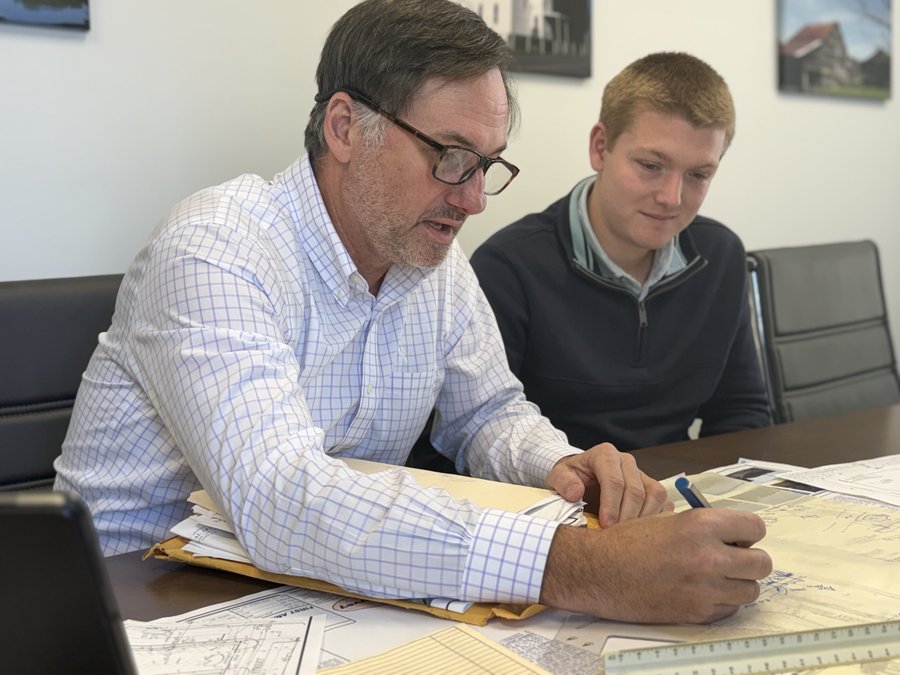
Beech, 23, now works with Rincon developer Jake Lang at Lang Commercial Real Estate, gaining experience in site selection, market analysis and commercial development — the kind of professional opportunity Lang says has not always been readily available in Effingham County.
“I wanted to come back,” Beech said. “This is home. But you have to have a reason to come back.”
For Lang, Beech represents both a success story and a warning.
A generational shift
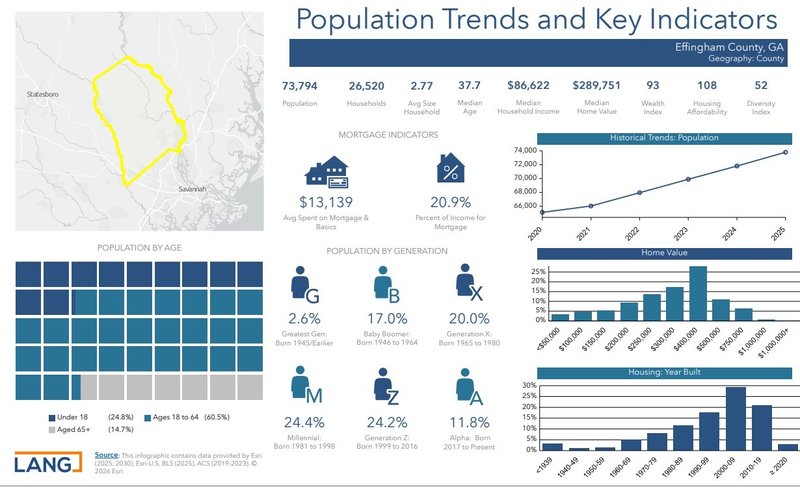
At a recent Effingham County Chamber of Commerce event titled “Catalyst Brief: Understanding Effingham County Through Data,” Lang pointed to a long-term trend: for nearly three decades, the county has steadily lost residents ages 18 to 24.
Data presented at the event showed a rising median age and shrinking average household size — indicators, Lang said, that the community is not retaining its young adults after high school and college.
“We’re educating 90 percent of our people,” Lang said. “But a lot of them are leaving. We’re not retaining that investment.”
Jessica Hood, Effingham County Industrial Development Authority vice president, said the trend is not unique to Effingham County. Many rural and suburban communities are experiencing similar declines in young professional populations, she said, driven in part by housing affordability, the concentration of professional and technical jobs in larger metropolitan areas and access to social and cultural amenities that appeal to young adults.
Those broader dynamics, she said, must be considered when evaluating local population trends and shaping long-term economic strategy.
Jobs at the center
Still, both Lang and Hood agree that job opportunity is central to whether young adults return.
While logistics and distribution remain an important part of Effingham County’s tax base, Lang said the community must recruit businesses that provide technical, professional and development-focused roles — jobs that make it feasible for young adults to build long-term careers locally.
He argued the county must pivot away from relying too heavily on warehouse development and instead prioritize industries that create skilled, higher-wage positions.
Hood said logistics and distribution will remain a significant component of the county’s economy, largely because of Effingham’s location along the I-95 and I-16 corridors and its proximity to the Port of Savannah. But she said the authority is actively working to diversify the industrial base by targeting higher-wage, more technical industries.
Recruitment and expansion efforts are focused on advanced manufacturing, precision fabrication and technology-driven production environments that require skilled technicians, engineers and maintenance professionals, she said.
She pointed to recent expansion announcements from Sewon America and Georgia Transformer, as well as Underwood Ammo’s planned manufacturing facility, as examples of projects expected to create positions requiring advanced technical skills and specialized training.
The authority has also expanded its focus beyond industrial recruitment. Through development of The Enterprise Building on Highway 21, a Class A office project, the IDA is targeting regional offices, administrative operations and professional services firms. One early tenant, True North Legacy Group, is relocating from Bluffton, South Carolina, establishing a professional services presence in the county.
Connecting education and industry
Education, Lang said, must be part of the solution. He called for stronger investment in technology and financial education and deeper partnerships between local schools and industry to align programs with long-term economic goals.
On that front, Hood said the IDA sees workforce development as one of its most important responsibilities. The authority works closely with the Effingham County School System, including the Effingham College & Career Academy, as well as Savannah Technical College and Georgia Southern University to help align training pathways with the needs of existing and prospective employers.
IDA staff serve on advisory committees at those institutions to ensure employer perspectives remain part of curriculum and workforce discussions. The authority is also a founding partner of RISE, a regional workforce initiative focused on career awareness and training alignment, and leads Workforce PhD, a multi-day program that provides high school seniors with hands-on exposure to local industries and direct engagement with employers. Graduates of the program are eligible for the Brandon Davis Memorial Scholarship to support their transition into the workforce.
Ultimately, Hood said, the goal is to create a clear and seamless connection between education and employment — one that supports existing industry, attracts new employers and provides residents with viable career pathways close to home.
One graduate’s perspective
Beech’s experience illustrates both the challenge and the potential.
After interning with Lang the summer before his senior year, he accepted a full-time role. His work includes financial modeling, development analysis, property management and marketing.
“I would say the main staple would be the financial modeling and stuff like that,” he said.
Still, he sees the broader pattern among his peers. Many of his high school classmates went straight into the workforce, taking jobs at Gulfstream, in construction or in the trades. Others attended nearby colleges such as Georgia Southern but did not return to Effingham.
“From high school, I’d say not many people are leaving with long-term plans,” Beech said. “A lot of people go straight to work. Most of my friends who are here now are old high school friends, and none of them went to college. They went to work at Gulfstream, or as electricians, in construction — jobs like that.
“There’s also a large group who went to local schools, but they didn’t come back. When I was leaving, I wasn’t thinking there were firms down here I could come back and work for. Those kinds of jobs don’t immediately come to mind.”
Beech said he hopes to stay in Effingham long term, but housing and career growth remain considerations.
“I don’t want to be mooching off my parents for too long,” he said. “I am looking to move out in the near future. But it’s expensive just to spend money on an apartment that’s never going to be yours, in my opinion.”
For now, his decision to return — and the kind of work he is doing — offers a glimpse of what could be possible if Effingham County succeeds in creating more opportunities for young professionals to build their futures at home.