
RINCON, Ga. — A Rincon couple says federal immigration agents aggressively stopped them during a Highway 21 roadside checkpoint, an encounter that left Aide Aguirre so rattled she went to the emergency room the next day with chest pressure and difficulty breathing. The couple describes the stop as frightening, confusing, and potentially motivated by racial profiling.
Aide Aguirre, a nine-year Rincon resident, U.S. citizen, business owner, and mother of four, said she and her husband, Jose Francisco, were driving home from dinner Friday, Nov. 7, when they encountered a long line of vehicles on Highway 21 and Towne Park Drive near Dairy Queen.
“When we saw the line of cars, we thought there may have been an accident and proceeded slowly,” Aide said.
The checkpoint — officially a safety operation organized under the Georgia Governor’s Office of Highway Safety (GOHS) — was conducted by members of the Southeast Traffic Enforcement Network (SETEN) and hosted by the Rincon Police Department. According to Rincon Police Chief Jonathon Murrell, the mission was to enhance traffic safety by targeting impaired driving, verifying driver’s licenses and vehicle registrations, and providing networking and training opportunities for law enforcement agencies.
Stop turns tense
But the Aguirres’ experience took a troubling turn.
Aide Aguirre (pronounced “I-day”) said the couple was first stopped at the checkpoint by an officer who requested Jose’s driver’s license. Jose, a legal U.S. resident and co-owner of local roofing business First Construction, handed over his license. The officer returned the license and waved them through.
Moments later, a second officer stopped them again, briefly checked the license, and allowed them to continue.
Gena Sullivan, communications director for the Rincon Police Department, said it’s not unusual for a vehicle to be stopped more than once during a busy checkpoint.
“It’s very chaotic,” Sullivan said. “There is a lot of traffic flowing through, and there are many agencies working to coordinate and communicate with one another.”
Tension turns to fear
Relieved, the Aguirres believed they were free to leave. Then, two agents wearing tactical vests marked “ICE” ran toward their van and ordered them to pull over to the side of the road.
The couple told the agent that officers had already cleared them twice and asked why they were being pulled over. The agent said the checkpoint was targeting “illegals using fake documents” and demanded to see Jose’s license and green card, which he handed over.
“One of them was wearing a green mask that covered his face and was very aggressive,” Aide said. “He started screaming and yelling for my husband to get out of the van and turn off the engine.”
Jose, trying to remain calm, was reluctant to comply. That’s when Aide said the masked agent reached through the window, grabbed the keys from the ignition, and threw them onto the dashboard.
“This is the first time we have ever experienced something like this,” she said. “We see it happening on TV — how intimidating ICE is and how they treat people. We never thought it could happen in Rincon. It’s very upsetting.”
Aide said another ICE agent approached the passenger-side window.
As the confrontation escalated, additional officers arrived, including a woman officer holding handcuffs and others shining flashlights into the van. The Aguirres feared the situation was spiraling out of control.
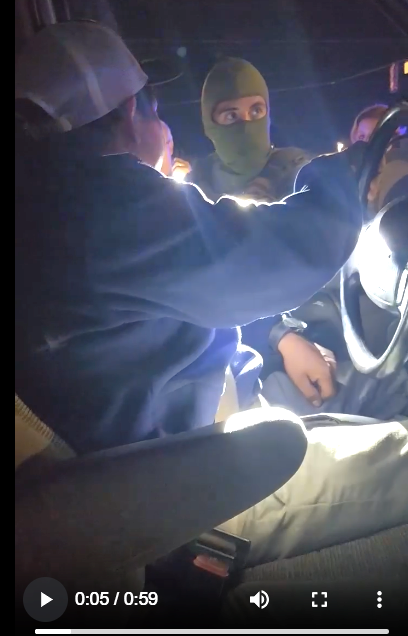
Aide said she voluntarily opened the van doors to show there was nothing illegal inside. She then turned on her dashcam, called her son, and began recording on her cellphone. She captured about one minute of video before a Rincon police officer intervened, telling the ICE agents the couple could leave.
The video shows a masked ICE agent at the driver’s-side window and Aide speaking with her son.
“They want Francisco to get out of the car, and we have given them everything,” she says frantically into the phone. Seconds later, an officer can be heard saying, “You’re clear to go. Have a nice evening.” Another officer adds, “Yes, she’s fine. I checked her. She’s a U.S. citizen.”
Aftermath of a frightening night
Aide said the experience left her rattled and angry.
“We were shaking when we got home around 10 p.m. We couldn’t fall asleep until 4 a.m.,” she said. “If it wasn’t for that Rincon officer, who knows what would have happened.”
The day after the stop, Jose drove Aide to the emergency room after she felt pressure in her chest and a sensation like she was gasping for air. A doctor diagnosed her with an anxiety or panic attack possibly triggered by the interaction with ICE the night before and advised her to follow up with a cardiologist. “I guess my nerves were still worked up,” she said.
Questions over ICE authority
At roadside checkpoints operated by local or state law enforcement, drivers are generally required to show a valid license, registration, and proof of insurance. Federal immigration officers present at such checkpoints have limited authority: they may ask brief questions about citizenship, but cannot detain motorists or demand additional documentation without specific cause or probable suspicion of a violation.
Sullivan and Murrell, who were not at the checkpoint, said they do not know why the ICE agents believed they had probable cause to stop the Aguirres for further questioning. Aide said she’s not buying the “fake documents” reason the ICE agent gave. She said she knows why: “It’s because we are brown.”
Aide said she understands the need for safety checkpoints but believes ICE’s actions went far beyond that purpose.
“We understand that the local officers were just doing their job,” she said. “But ICE — they’re not just deporting violent criminals like they said they would. They are racial profiling, harassing, and targeting everyone.”
Multiple attempts to reach the ICE field office in Atlanta for comment were unsuccessful.
A regional safety operation
The checkpoint in Rincon was part of a larger regional traffic safety operation. SETEN is a regional traffic enforcement network overseen by the Georgia Governor’s Office of Highway Safety. The network coordinates monthly enforcement efforts among agencies in Effingham, Chatham, Bryan, Bulloch, Candler, Screven, and Evans counties, focusing on issues such as impaired driving, narcotics trafficking, speeding, and seat belt compliance.
Sullivan said participating agencies at the Nov. 7 checkpoint included the Rincon Police Department, Effingham County Sheriff’s Office, Chatham County Sheriff’s Office, Savannah Police Department, Garden City Police Department, Pooler Police Department, Chatham County Police Department, Tybee Island Police Department, Bryan County Sheriff’s Office, Port Wentworth Police Department, Georgia Ports Authority Police, Screven County Sheriff’s Office, Candler County Sheriff’s Office, Georgia State Patrol, and the Georgia State Patrol Nighthawks DUI Task Force.
Sgt. Jamie Thompson of the Effingham County Sheriff’s Office, who coordinates SETEN, said ICE — the U.S. Immigration and Customs Enforcement Agency — is not part of SETEN. ICE operates under the Department of Homeland Security and enforces immigration and customs laws at the federal level. GOHS and its networks operate independently of federal immigration.
Murrell said the checkpoint was a standard SETEN safety operation coordinated among regional partners.
“ICE sometimes participates and sometimes it doesn’t,” Thompson added.
Murrell also noted that local police have limited authority over federal officers.
“ICE is a federal agency,” Murrell said. “Who am I to tell a federal agency they can’t participate? The police department also has no jurisdiction or authority over how ICE agents conduct themselves during these checkpoints.”
Community on alert
Across Effingham County, members of the Hispanic community are uniting, using Facebook to share news and protect each other.
“A lot of people are afraid to go out because of ICE and bounty hunters who are paid $2,000 per head, to turn over Hispanics,” Aide said. Neighbors and friends warn job sites, run errands, and share alerts. “This isn't fair to hard-working families who work, pay taxes, and obey the law.”
Aide said she and her husband have not filed a legal complaint but are considering it.
“If we try to do something, nobody will do anything about it,” she said. “We are Hispanic, and we don’t mean anything to anyone.”