SPRINGFIELD, Ga. — Effingham Parkway’s anticipated May opening has been pushed back to at least late July, and the full completion timeline is now uncertain as officials work through drainage concerns that have prompted additional design considerations.
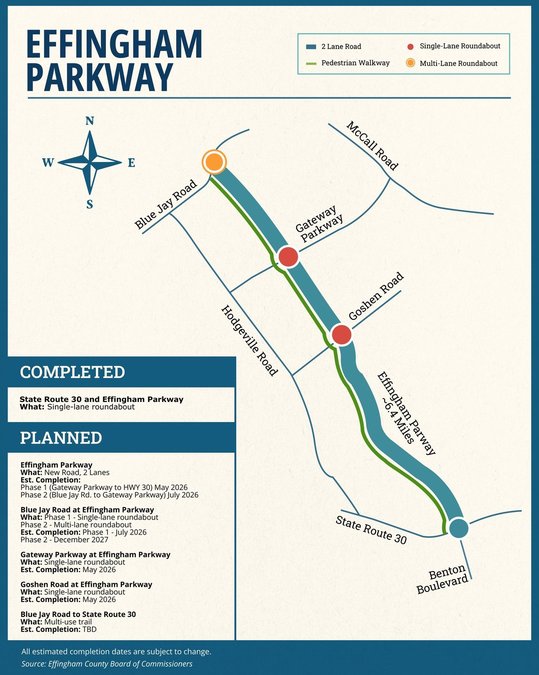
The Georgia Department of Transportation said a portion of the parkway from Blue Jay Road to Goshen Road is now expected to open by the end of July — a shift from earlier guidance that Phase 1 would be completed by May 31.
GDOT did not directly confirm the delay but said “additional enhancements” are being considered in coordination with the U.S. Army Corps of Engineers to improve drainage and minimize environmental impacts.
When asked about the cause of the timeline change, the agency said “potential design changes may occur due to environmental considerations” but did not provide specifics.
A revised completion date for the full 6.4-mile corridor has not been determined. While the project’s contractual completion date remains July 31, 2026, GDOT acknowledged that timeline could be extended.
State transportation board member weighs in
Effingham County’s representative on the state transportation board, Ann Purcell, confirmed that the portion of the parkway between Blue Jay Road and Goshen Road is expected to open in July.
“Blue Jay Road to Goshen will be open in July,” Purcell said. “That part will be ready.”
However, she said the broader timeline for completion remains uncertain as engineers continue evaluating drainage concerns along the corridor.
Purcell said those issues are driving continued adjustments to the project.
“We want to slow the project down and correct any drainage problems so flooding will not happen again,” she said.
Flooding concerns raise new questions
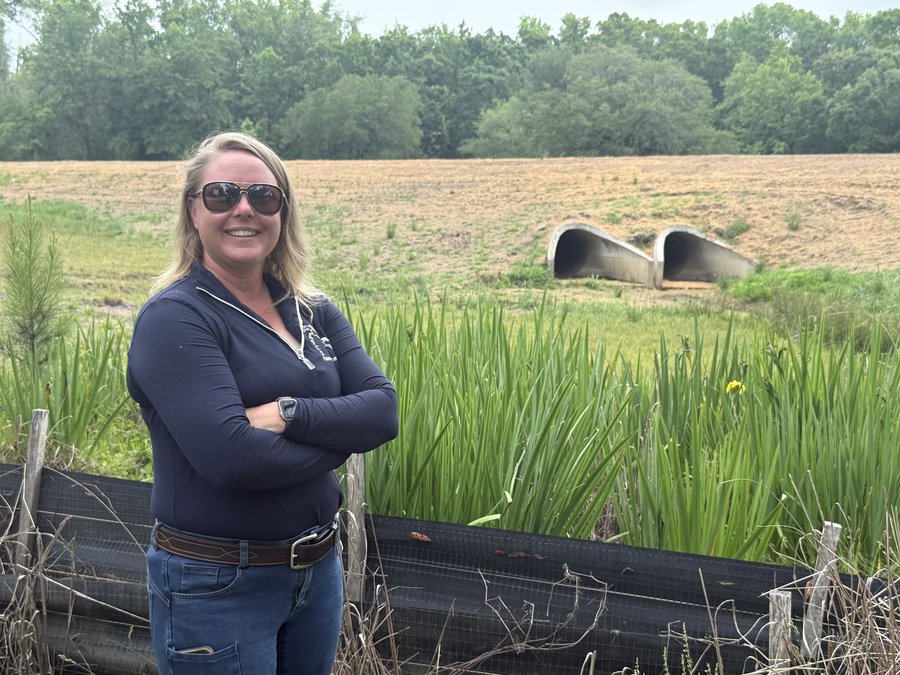
The timeline shift comes after significant flooding last August at a property along Forest Haven Drive, where a local equestrian farm owner said construction altered drainage patterns and sent water onto her land.
Justyne Albright, owner of FCS Equestrian Center, said her property, which is in a FEMA-designated flood plain, was submerged in up to four feet of water and remains uninhabitable.
“They have it flowing down Forest Haven to get to the marsh,” Albright said. “We had water coming from both sides.”
She said the issue stems from how drainage infrastructure was installed along the project, preventing water from flowing naturally through the system.
“The culverts aren’t correct,” Albright said. “There’s a lip, and the water just sits there. You’d have to have at least a foot of water before it would even start flowing through.”
She said the result is standing water that has fundamentally changed the landscape — even during dry conditions.
“This was never wet back here,” she said. “Now it’s holding water even in a drought.”
Albright said engineers have discussed replacing a portion of the raised roadway, or berm, with a bridge to restore natural water flow. GDOT has not confirmed the construction of a bridge.
County: Issues known, GDOT leads timeline
Effingham County Manager Tim Callanan said officials are aware of drainage challenges in the corridor but emphasized that GDOT controls construction and scheduling.
“We know there have been challenges in that corridor,” Callanan said. “Anytime you’re dealing with wetlands and a high water table, drainage is a critical component.”
He added that while the county led the roadway design and right-of-way acquisition, all plans were subject to GDOT review and approval.
“GDOT manages the construction and the timeline,” Callanan said. “Our role is to stay engaged and advocate for solutions that address residents’ concerns while keeping the project moving forward.”
Major investment with potential cost increases
The 6.4-mile parkway, stretching from State Route 30 to Blue Jay Road, has been a major infrastructure priority aimed at relieving congestion on State Route 21 and supporting continued growth in Effingham County.
The project was originally estimated at approximately $76 million, with Effingham County contributing about $25 million toward design and right-of-way acquisition. Construction was awarded in 2020, with GDOT overseeing funding and construction management.
Since then, upgrades to intersection designs — along with ongoing drainage concerns that may require additional redesign work — could increase the overall cost of the project, though officials have not provided an updated estimate.
Residents still dealing with impacts
For Albright, the uncertainty extends beyond construction schedules.
Her home remains uninhabitable, and she and her husband are living in a small space inside their barn while trying to sustain their business.
“There’s no point in fixing anything until they fix the problem,” she said. “Otherwise, it’s just going to flood again.”