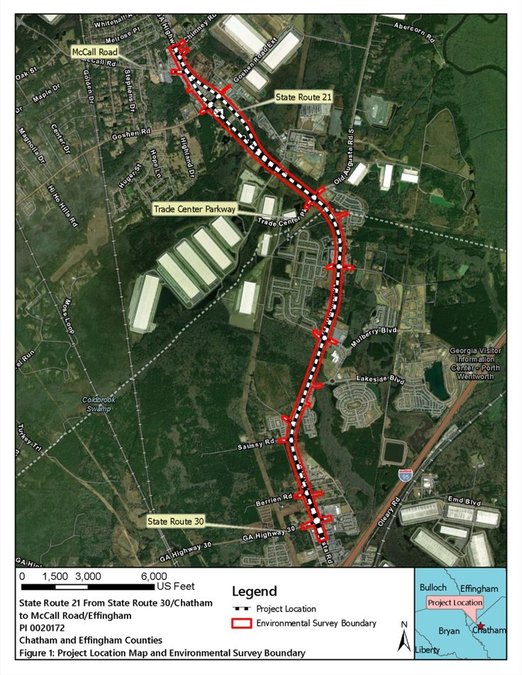
RINCON, Ga. — Relief for thousands of motorists who battle traffic congestion on State Route 21 every day could be coming sooner than expected.
The Georgia Department of Transportation presented plans Nov. 12 for a $123 million project to widen approximately 5 miles of the heavily traveled highway from four to six lanes between State Route 30 and McCall Road.
The public information open house at the Macomber Park Building in Rincon gave residents an opportunity to examine preliminary designs, ask questions and provide feedback on a project intended to improve traffic flow and safety.
Construction could begin in 2028, with completion targeted for 2031, according to Jill Nagel, GDOT's district communications officer.
The project represents a major step toward addressing traffic congestion that local officials say has become one of Effingham County's most pressing problems.
"It's the number one issue facing our citizens, bar none," said Rincon City Councilwoman Mona Underwood, chairwoman of the Effingham County Transportation Advisory Board.
"If you've ever tried to get out of Effingham County at 7 o'clock in the morning or try and get back into Effingham County at 5 o'clock in the afternoon, it is a nightmare," Underwood said. "So people trying to get to work and then get back to their families, it's a task."
Underwood called the congestion a quality-of-life issue that affects residents throughout the county.
A $123 million investment
Nagel said the project's estimated $123 million price tag includes preliminary engineering, right-of-way acquisition, construction and utility work. Construction alone is expected to cost approximately $99 million.
Funding has been secured, she said, allowing GDOT to move ahead with a project identified as a priority in the 2023 Coastal Empire transportation study.
"This is going to help with traffic flow, but also enhance safety, not only for commercial vehicles, but also for commuter vehicles," Nagel said.
The project is expected to take approximately 36 months to complete once construction begins, although the schedule could be affected by utility relocations and other factors.
Right-of-way acquisition is scheduled to begin in 2027.
Nagel emphasized that GDOT has designed the improvements to remain within the existing highway corridor wherever possible, reducing the need to acquire additional property.
Although some land purchases will be necessary, the current design does not require any homes or businesses to be displaced.
How the highway will change
One of the most noticeable changes will be a narrower grassy median separating northbound and southbound traffic.
Nagel said engineers plan to accommodate much of the additional roadway width by expanding toward the center of the highway rather than outward onto adjoining properties.
"We're focusing on designing it on the interior," she said.
The median will remain, but its width will be reduced to make room for an additional travel lane in each direction.
Some sections will require expansion beyond the existing pavement, although GDOT intends to minimize those impacts.
The design also emphasizes controlling access to the highway to improve traffic movement and reduce potential conflicts between vehicles.
Nagel said median openings will be limited to designated locations, including signalized intersections and approved crossings, rather than allowing unrestricted turning movements.
"It's all about safety when it comes to design," she said.
Another question is how construction will affect motorists already dealing with significant delays.
Nagel said GDOT has not yet confirmed whether most construction will take place during daytime or nighttime hours.
She acknowledged that nighttime construction could reduce disruptions during peak commuting periods but would also increase costs because of additional lighting and safety requirements.
A commuter's perspective
Rincon Mayor Kevin Exley knows firsthand what residents endure on SR 21.
Exley said his daily 26-mile commute to Savannah typically takes an hour and four minutes. An accident can stretch that trip to 90 minutes or even two hours.
His wife, Kelli, faces a similar commute, often arriving home between 6:30 and 7 p.m. after leaving work at 5 or 5:30 p.m.
The hours spent sitting in traffic take away from time at home, Exley said.
While he welcomes the widening project, the mayor worries that stopping the improvements at McCall Road could simply push the congestion farther south.
He compared the highway to a 2-liter bottle and a 20-ounce bottle. Regardless of their size, both have narrow openings that restrict how quickly their contents can flow.
"All you're doing is moving the bottleneck," Exley said.
He believes the widening should extend to Jimmy DeLoach Parkway, where many commuters turn toward Gulfstream, the airport and other major employment centers.
"My only problem with this project is it didn't get shifted far enough to get it to Jimmy DeLoach," he said.
Exley hopes future improvements involving Interstate 95 will help address that concern.
Still, he acknowledged the current project represents progress.
"It's still relief," he said.
From 2050 to 2028
For Underwood, the accelerated timeline is particularly significant.
She said Rincon officials were told during discussions in January 2024 that improvements to the highway might not occur until 2050.
Rather than accept that timeline, she said, city officials began pushing for action.
"The city of Rincon. We were the voice for our citizens," Underwood said.
She credited cooperation among Rincon officials, Effingham County leaders and state lawmakers Jon Burns and Bill Hitchens with helping move the project forward.
According to Underwood, the lawmakers helped push for an updated traffic study that elevated the importance of improvements along SR 21.
"We got together with the county, Jon Burns, Bill Hitchens, we said we got to do something, guys. We need help," she said.
Underwood said the resulting work helped move the first two phases of SR 21 improvements higher on the state's priority list.
By spring 2025, she said, engineering and design work was already underway.
Nagel also pointed to the 2023 Coastal Empire study, which examined regional transportation needs, including the movement of freight from the Port of Savannah.
Underwood said the earlier construction timeline represents a major improvement over what local officials initially anticipated.
"It's much better than 2050," she said.
Public comments accepted through Dec. 12
Although the open house was a one-time event, residents still have an opportunity to review the SR 21 widening plans and submit comments.
GDOT's virtual public information open house will remain available through Dec. 12.
Nagel encouraged residents to examine the plans carefully and raise concerns while the project is still in the design stage.
"Now is the time, not when we start construction," she said.
The online materials include the same displays presented at the Nov. 12 open house, along with additional project information.
GDOT will review the comments and prepare written responses addressing questions and concerns. Residents who provide valid mailing addresses will receive response letters.
"The department wants input from the community," Nagel said. "We're having this meeting tonight so we can listen to their concerns, to look at the design, and tell us what they think."
Residents can find project information through the Georgia DOT Public Outreach website by searching for Project ID 0020172.