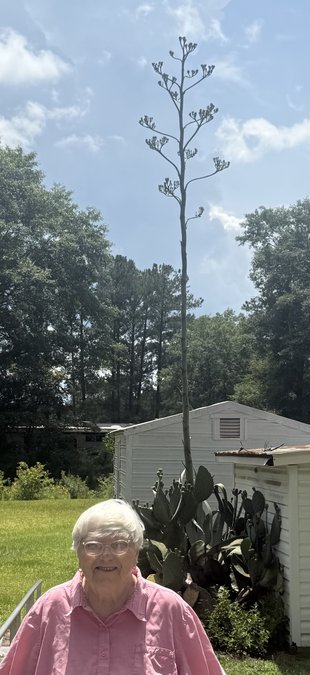
SPRINGFIELD, Ga. — When Mildred O'Connor looked out into her yard in the Forest Hills subdivision a few weeks ago, she noticed something unusual.
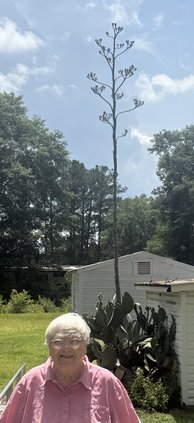
A stalk had appeared on a large agave plant that had been quietly growing beside her home for years. Within days, the stalk seemed to shoot skyward. Before long, it towered more than 30 feet above the yard.
"It just kept growing and growing and growing," O'Connor, 80, said. "I couldn't believe it."
A neighborhood curiosity takes root
The plant, commonly known as a century plant, has become something of a neighborhood curiosity. Friends regularly stop by to check on its progress, and O'Connor's granddaughter, Megan Watkins, has watched in amazement as the towering stalk transformed the landscape.
The century plant, scientifically known as Agave americana, is one of the most striking succulents found in warm-climate landscapes, according to Effingham County Agriculture and Natural Resources Agent Phillip Torrence.
Rapid growth and striking form
Despite its name, the plant does not take 100 years to bloom. Most reach maturity in about 8 to 30 years. When flowering begins, a tall stalk can surge from the center of the plant, sometimes growing several inches a day and reaching 20 feet or more, topped with clusters of pale yellow or white flowers that can be seen from a distance.
Torrence said the plant’s blue-green leaves are another defining feature, often growing several feet long and forming a rosette that can spread up to 12 feet across. Their sculptural shape has made century plants a common choice in drought-tolerant landscaping, though he noted they should be placed carefully because of sharp leaf tips and spined edges.
Myths, caution, and misunderstood names
Despite its dramatic appearance, the plant is often surrounded by myth. Some people mistakenly refer to it as a “corpse plant” and believe it emits a rotting smell when it blooms. That description actually belongs to a different species altogether. While some agave blooms may attract pollinators with strong scents, the century plant is not the infamous corpse flower known for its foul odor.
Many century plants die after flowering, though some species produce offshoots, or “pups,” that continue the plant’s life cycle.
A tribute growing in the backyard
For O'Connor, the plant is more than a botanical curiosity. It was already growing in the yard when she married her late husband, Roy O'Connor, a Navy veteran and retired Gulfstream employee who passed away last year.
"I think in a way it's kind of a good tribute to my husband," she said. "He would have been so excited about it."
As the towering stalk continues its rapid climb, O'Connor and her friends keep a close watch, waiting to see when — and how — it will finally bloom. In the meantime, a plant that spent years blending into the background has suddenly become the most talked-about feature in the neighborhood.