RINCON, Ga. – When OpenAI announced plans for a $20 billion data center campus in Effingham County, many residents had the same question: How did a project of this size get this far before the public knew about it?
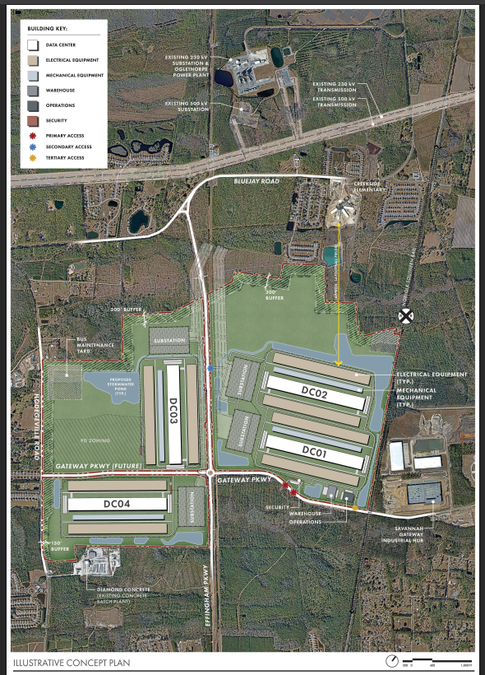
Project Camellia, a planned 1,400-acre data center campus at the Savannah Gateway Industrial Hub, was announced July 22 and followed by a public information open house the next day. Transparency concerns dominated that meeting, with residents saying they felt blindsided and questioning why there had been no public meetings or votes before the project was announced.
“This would have been helpful six months ago,” Rincon resident Diane Kreinbrink said. “Now it seems back-handed. Like they are saying, ‘Suck it up and deal with it.’ Transparency is terrible like they are hiding something.”
The answer lies in decisions made over the past two decades — beginning with the Effingham County Industrial Development Authority's purchase of the land in 2006, a 75-year development agreement approved in 2016, longstanding industrial zoning and confidentiality agreements that kept the project out of public view until its announcement.
How the groundwork was laid
The land that now makes up the Savannah Gateway Industrial Hub was first identified by the ECIDA in 2004 and acquired in 2006.
The ECIDA purchased the property near Rincon for about $31 million from International Paper after condemning it for industrial development. Over the following years, the authority considered several concepts for the property, including rail connections and recreational uses.
In 2016, the ECIDA entered into an agreement that changed how the property would be developed. During a Feb. 18, 2016, meeting, the board voted 7-1 to partner with OmniTRAX in collaboration with Broe Real Estate Group. None of the current ECIDA board members participated in that vote.
The agreement allowed the ECIDA to recoup debt from the 2006 land purchase while giving Broe Real Estate Group and OmniTRAX a central role in developing the property.
Under the agreement, Broe and OmniTRAX became the property’s sole and exclusive agent, attorney-in-fact and master developer. The agreement gave the company broad authority to market, negotiate and develop projects on nearly 2,600 acres of ECIDA-owned land, including the site where OpenAI plans to build its data center campus.
As the ECIDA’s master developer, Broe has the authority to execute contracts, applications and other agreements on behalf of the development authority without transparency. Individual projects are then submitted to Effingham County through the site plan review process.
Brandt Herndon, CEO of the ECIDA, said the authority followed the same development process it has used for years at the Savannah Gateway Industrial Hub.
Under the 2016 agreement, signed before Herndon became CEO, he said Broe serves as master developer because the ECIDA lacked the staff and financial resources to develop roughly 2,600 acres on its own.
“There’s some good and bad in the agreement, but the agreement is the agreement,” Herndon said. “I inherited the agreement. ... That’s what we have to go by.”
Why the public didn’t hear sooner
While the development agreement explains who had authority over the land, it was a confidentiality agreement that shaped when and how residents would learn about the project.
Herndon said the ECIDA signed a nondisclosure agreement with OpenAI that prohibited officials from publicly discussing the project before the announcement. He said about 75% of the companies the ECIDA works with require nondisclosure agreements during the site selection process.
“Companies, when they start looking to either expand or relocate, they need confidentiality,” he said. “That’s how all development authorities operate, not only in Georgia but in every state. If we’re required to sign an NDA, we’re going to … and we’re going to honor it.”
Herndon said the ECIDA’s decision to follow the confidentiality agreement was consistent with how economic development projects are handled throughout the country.
However, the confidentiality surrounding the project became one of the main concerns raised by residents, who said they wanted an opportunity to learn about and discuss the project before it reached the announcement stage.
Why no rezoning was required
Effingham County Manager Tim Callanan said the county has little to do with development decisions at the Savannah Gateway Industrial Hub.
However, county commissioners did make decisions that affected how projects such as Project Camellia could move forward.
In January 2025, commissioners unanimously approved a Table of Permitted Uses in the county’s Code of Ordinances that specifically listed data centers as a permitted use in light industrial zoning districts. In April 2025, the table was expanded to include heavy industrial zoning.
Callanan said the Savannah Gateway property has been zoned for industrial development since 2006.
“This property in 2006 was zoned industrial,” he said. “Since a data center is a permitted use in industrial zoning, it didn’t require a rezoning or a change in use classification.”
Callanan said data centers likely would have been considered a heavy industrial use even before they were specifically listed in the ordinance.
“It may not have been listed prior to the table of permitted use, but that’s where it would have gone if that request had come in,” he said. “My understanding is we took a fairly standard list of classification of uses and did not specifically say, ‘I want data centers in there.’ It wasn’t by request.”
Callanan noted that about 6 million square feet of warehouse space has already been developed at the Savannah Gateway Industrial Hub without county approval beyond the site plan review process. Those companies include Aertssen, DHL, Elogistic, Kyungshin America and Quantix.
“This is simply rather than building what probably would have been about 8 million square feet of additional warehouse space, they’re building 4 million square feet of data center,” he said.
Callanan said OpenAI officials began communicating with the county in early 2026 and have expressed a willingness to address public concerns.
“Just because something is moving forward doesn’t mean it can’t be tweaked or changed for the better,” he said.
OpenAI officials have shared that they plan to seek community input as the project unfolds.
“We have to earn the trust, we have to earn the right to build this,” said Chris Lehane, OpenAI’s chief policy officer. “Part of earning that right and earning that trust is to actually hear back from people.”
Why tax incentives were offered
The ECIDA retained the authority to offer incentives to companies locating at the Savannah Gateway Industrial Hub under its agreement with Broe Real Estate Group.
The authority exercised that option for OpenAI, approving a 50% property tax abatement for 15 years during a meeting the evening before the July 22 announcement.
The timing of that approval became another point of interest for residents because the incentive was approved before the project was publicly announced.
Herndon said the incentive was not required under the development agreement but was offered because of the project’s size and because the authority believed it would provide a better long-term financial outcome than placing the property directly on the tax digest.
He said the tax abatement structure protects the public taxes that the Effingham County School System receives from the state, which could otherwise be affected by a large increase in the county’s tax digest.
He also said the agreement locks OpenAI into paying taxes based on the county’s 2026 millage rate for 15 years, even if local governments reduce their millage rates in the future.
“It was a way to protect the school,” Herndon said. “It’s a win-win for everybody.”
What’s next
The submission process for a Development of Regional Impact application to the Coastal Regional Commission began July 22.
A DRI is a large-scale development that is likely to have regional effects beyond the local government jurisdiction where it is located. While the process allows affected governments to review potential impacts, the final decision on whether to move forward with a project remains with the host government.
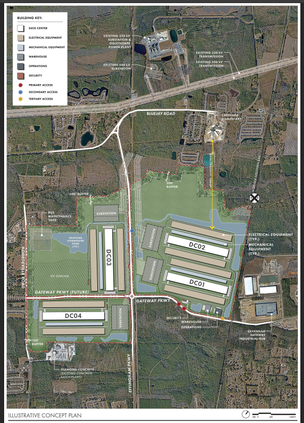
The initial DRI identifies Project Camellia as four buildings totaling 4.4 million square feet. The listed developer is Macon-based Octans GA LLC, care of Butler Snow. The application seeks permits that include, but are not limited to, certificates of occupancy, tree removal and business licenses.
Herndon said the DRI is expected to be fully submitted July 27 with what he described as “the best site plan possible,” although he said revisions are likely. He expects the DRI review to take about 45 days before county review of the project’s site plan begins.
Jake Ziegler, the county’s director of public engagement, said the next major step is submission of the project’s site plan. Once county staff completes its review, the plan will be scheduled for consideration by the Board of Commissioners.
As of Monday afternoon, Ziegler said the county had not yet received the site plan and therefore could not say when it would appear on a commission agenda.
“We will certainly keep … the public informed when a date is provided,” he wrote.
Herndon said OpenAI also plans to hold additional public meetings as the project moves through the review process, although no dates have been announced.