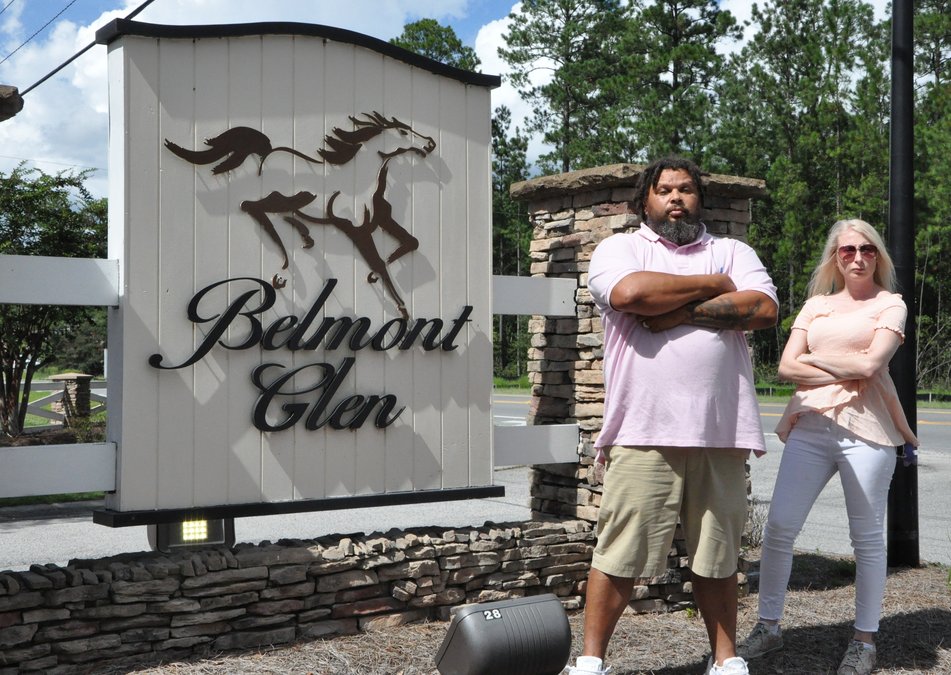
GUYTON, Ga. — On Friday nights, Belmont Glen’s recreation area is packed and lively.
Nearly 100 kids fill the outdoor space, playing basketball, soccer and tennis. They ride their bikes, swim in the pool and fish in the lake.
On clear nights, residents can gaze up at the stars. The quiet and open skies are among the reasons many said they moved to the area.
Recently, though, those carefree evenings have been clouded by worries about a new neighbor: a 1,400-acre OpenAI data center campus set to be built across the street.
Known as Project Camellia, the data center will be located within the Savannah Gateway Industrial Hub in Effingham County. A county 500kV transmission line project is also planned to power it. OpenAI and county officials have described Project Camellia as a long-term investment in the county.
But the site is within a few miles of more than 500 homes and two elementary schools.
Neighbors have raised concerns about noise and light pollution, construction traffic and the area's power grid and the impact of adding 3.2 gigawatts of energy demand.
“We’re scared we’re going to lose our oasis – that our serenity is going to be disrupted,” Elizabeth Fisher, a Belmont Glen resident since 2019, said.
Residents also worry about unknown health impacts from constant operation of heavy electrical and cooling equipment, especially for the children who attend school across the street.
“Data centers don’t belong in the middle of residential areas and in the middle of schools,” Crystal Hayes, a Belmont Glen resident, said.
Residents believe the data center is invading a residential area. County officials counter that the industrial land was there first.
An unwelcome neighbor
Belmont Glen residents describe their pocket of Effingham County as a slice of rural life within a rapidly developing county.
Many moved into the neighborhood before development began in the Savannah Gateway Industrial Hub, in 2019. They referred to the wooded space across Hodgeville Road as the “Christmas tree farm.” Some said their realtors didn’t disclose the proximity to industrial zoned land. Others saw that the space had sat empty for 20 years and assumed industrial development was a distant concern.
Tim Callanan, Effingham County's manager, said the land containing the industrial property and the areas that eventually became Belmont Glen were once part of a much larger tract owned by International Paper. The original plan for the land was a massive mixed-use community, including thousands of homes, schools and commercial development.
However, the Effingham County Industrial Development Authority determined the property would be better suited for industrial development and condemned much of the larger tract in 2004. According to Callanan, the portions on the residential side of Hodgeville Road remained under the planned-development zoning intended for housing.
That history has produced a land pattern where residential neighborhoods and schools now neighbor a large industrial park.
Belmont Glen residents acknowledge that the property was industrially zoned before many of their homes existed. But they argue that what is now legally possible on a piece of land is not necessarily what residents expected when they bought their homes.
“A hyper scale data center wasn't a thing when I decided to move here, and I had no idea that it could be considered to be so close to my property,” John Smith, a Belmont Glen resident, said. “It wasn't on the permitted uses table when I moved here.”
Raymond Carver, who moved to Belmont Glen about three and a half years ago, said he knew the land was industrial when he bought his home. But he questions why the county would allow a data center so close to a neighborhood.
Carver has now joined other nearby residents to sue the county over a 2025 zoning change that permitted data centers.
“When you start zoning houses and schools around that industry, it doesn't even make sense to put something as heavy as a data center there,” Carver said.
Local leaders argue a data center is a much lighter industrial use than what could’ve gone into the industrial park.
“It probably would have been logistics, and I live that every day and know how loud and intrusive that is,” Effingham County District 2 Commissioner Roger Burdette said. “It would’ve been a lot of trucks on the roads. An asphalt plant could have gone in there, and you would’ve smelled that for miles.”
Carver said residents might have preferred the more familiar impacts of a warehouse to the uncertainties surrounding a data center.
“They’re not making constant noise all day,” he said. “Yeah, they’d (warehouses) add traffic, but so will OpenAI for the next five years for their build-out.”
Residents complain of already-existing infrastructure issues – power outages, flooding and traffic – that they fear a 1,400-acre data center campus will exacerbate.
OpenAI has ruled out some traditional concerns associated with data centers. The completed project will not have onsite diesel generators, the company said, and it will use a closed-loop cooling system without access to groundwater.
Residents, however, point to other potential impacts, including heat from computers operating around the clock, cooling-equipment noise, low-frequency sound and exposure to low-frequency electromagnetic fields associated with electrical equipment and the planned transmission infrastructure.
“They’ve put our kids right into the industrial area,” Manjusha Prasad, a Belmont Glen resident, said. “The heat impact that's going to happen, the noise impact that's going to happen does affect health. It affects their ability to pay attention to school.”
Hayes said she’s tried to give OpenAI the benefit of the doubt but remains concerned about transparency.
At the end of August, the Belmont Glen Homeowners Association hosted a meeting with OpenAI. The board asked residents to submit questions, but they weren’t allowed to attend. About three weeks later, residents haven’t received information about the meeting. An OpenAI spokesperson told the Effingham Herald that they couldn’t speak on what was a “private meeting.”
Burdette, who attended, said OpenAI officials were concerned about security.
“They don’t mind small meetings,” he said. “But, they want to meet in some kind of area that’s secure.”
Hayes said it’s hard to build trust without answers.
Industrial development near homes
Brandt Herndon, CEO of the ECIDA, wrote in an email that industrial, commercial and high-density residential development often cluster around the same water, sewer, road and electrical infrastructure.
Industrial sites can be identified or acquired years before they are fully developed, he wrote. In some cases, residential growth later surrounds land already designated for industrial use.
“ECIDA does not pursue every project that expresses interest in the community,” he said. “It is not uncommon for us to decline or step away from projects that do not align with available infrastructure and resources, the characteristics of a particular site, or broader community interests. We have done so on multiple occasions in the past.”
The Savannah Gateway Industrial Hub is unique because the land was owned by the ECIDA but OmniTRAX, a national rail company, has full developmental rights. The land was sold for $350 million to OpenAI’s Octans GA LLC in August.
Callanan said Effingham County commissioners, particularly Burdette, attempted to reduce the potential intensity of development at the site.
In the most recent comprehensive plan update, the county designated part of the industrial property as “transitional” on its future land-use map with the potential for a mix of business, commercial and multifamily development.
Callanan said the county tried to persuade OmniTRAX to adopt the less-intensive approach. Those discussions did not result in a change, and the property remained industrially zoned.
Still, he said he believes a data center falls into a lighter use category when it comes to traffic, water use and noise.
“I understand people's concern because data centers have earned the reputation that they have,” Callanan said. “But what is proposed here is not remotely similar to what has been put in places like Virginia.”
County officials also feel confident in Effingham’s industrial buffer and downward-facing, shielded lighting requirements.
Callanan said OpenAI has agreed to commitments beyond existing county requirements for noise, lighting and other impacts. The preliminary OpenAI site plan shows a 300-foot buffer, an existing berm and an acoustic wall, which Callanan said he believes will significantly limit visibility and noise from the facility. Noise-monitoring equipment will be installed around the site’s perimeter.
The IDA published a noise fact sheet recently outlining the approach to buffers, noise studies, monitoring, and compliance with the county’s noise ordinance.
An OpenAI spokesperson said the company is working with an outside engineering firm on a sound study, starting with measurements of existing noise around the site.
“That baseline will help inform how we design the campus and incorporate measures to minimize noise for nearby residents,” the spokesperson wrote in an email. “That work is happening as the site design develops, so we don’t yet have final noise projections or a completed mitigation plan to share.”
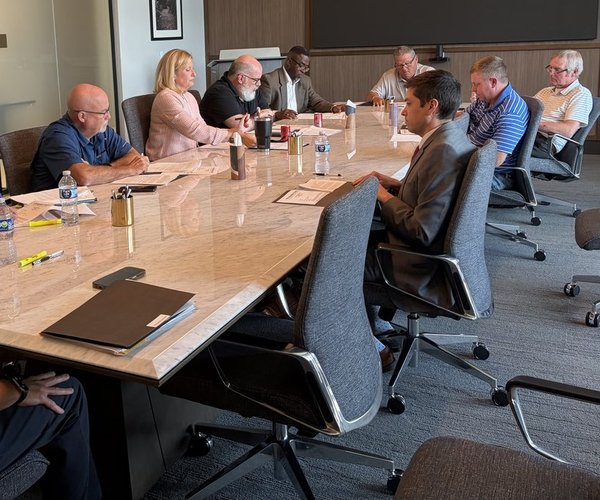
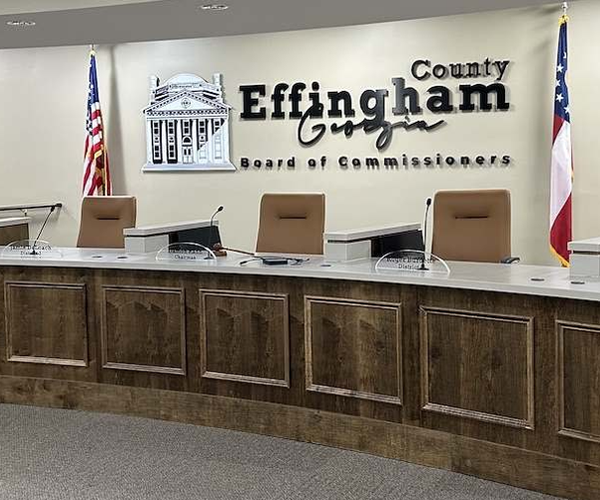
Callanan said these commitments will be formalized through a data-center ordinance – which Effingham County commissioners discussed during a Tuesday work session – or development agreement, while water and sewer commitments would be included in a separate agreement.
“Once it's all built, our goal is, unless you drive by, you don't even know it's there,” Callanan said.
Burdette said he’s confident in the promises OpenAI has made to mitigate impacts on his constituents who live near the future site.
“They are active and they are attentive,” he said. “They keep demonstrating over and over that they really want to partner and get this right.”
Unanswered questions
Still, Burdette said he has lingering concerns, including low-frequency sound and EMFs, which he said he is looking into more.
“I’m really concerned about construction. It’s going to be intense,” Burdette said. “We’re trying to get ahead of it.”
He said he’s working with OpenAI officials on how to best mitigate traffic concerns but that the completion of the Effingham Parkway will be critical to managing traffic.
Callanan said the first section of the Effingham Parkway, connecting Goshen Road to Blue Jay Road, is expected to open by Sept. 30.
The remaining portion of the Parkway is expected to take longer, pending a Georgia Department of Transportation change order. Once that change order is signed, he said, the work is expected to take about nine months. If the agreement is finalized by the end of September, that would put completion around May 2027.
Callanan said the timing is important because the data center project still has to move through several approval processes before major construction begins. The site's plan approval has been delayed about 45 days while county officials seek additional information, including a water and sewer agreement. The project also must receive other required approvals and a land-disturbance permit before the site can be cleared.
Callanan said hopefully the Parkway is open by the time significant site work begins, giving construction traffic a route away from residential roads.
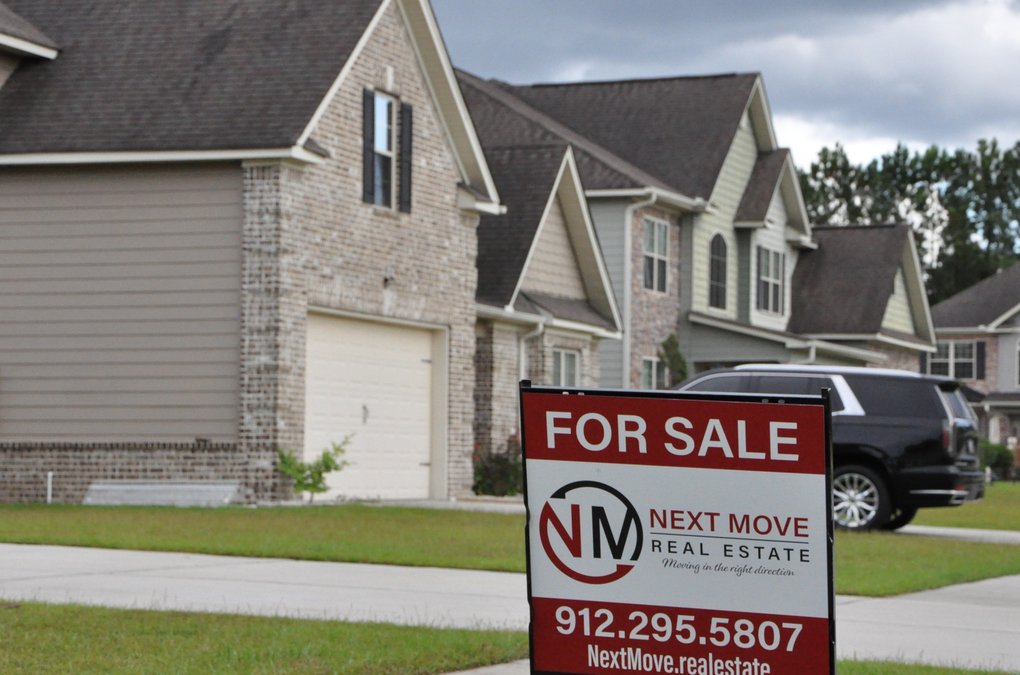
Hayes said her next door neighbors have already put their home on the market since the data center announcement. Prasad said she’s consistently looked into moving out of the neighborhood.
“Our family has three homes here … ages 5 to 85 in our family,” she said. “Trying to move now and disrupt all that is not what we’re looking to do.”
County officials argue that the development will bring substantial tax benefits and help reduce the property-tax burden on existing homeowners. Callanan said he expects those benefits, along with continued investment in schools, public safety, recreation and infrastructure, to make the county more attractive over time. But he acknowledged there could be short-term effects from the uncertainty surrounding the project.
Residents, meanwhile, are asking for more certainty and more control over what happens next.
They want protections if property values fall, including consideration of a housing or compensation benefit tied to the development. They also want homestead exemptions to be automatic and are calling for property-assessment protections.
“They’re not capping our assessments,” Prasad said. “So, lock us in, just like you’re locking OpenAI in.”
But Effingham County homeowners with a homestead exemption already have protections against large increases in the taxable value of their homes.
Tax Commissioner Daniel Rodewolt said Effingham County did not opt out of Georgia’s House Bill 581, which created a statewide floating homestead exemption beginning in 2025. The law limits increases in a homestead’s taxable value to the annual inflationary rate, rather than allowing the taxable value to rise with the full increase in the property’s assessed value.
Effingham also has a separate local homestead valuation freeze. The Georgia Department of Revenue lists Effingham among the counties with such an exemption.
Rodewolt also pointed to a local homestead provision dating to 2009 that limits increases in the taxable amount for a homesteaded property to 3% when the property’s assessment rises.
The existing protections, however, do not directly address the broader concern raised by residents about how the construction of a massive data center could affect their property values or their ability to sell their homes.
Hayes said she’d consider the promised benefits of the project if the IDA, the county and OpenAI started over, going through public processes and votes.
“They should have heard us out before,” she said.
However, Hayes said the lack of transparency or public input with the OpenAI project has ultimately revealed a larger failure of Georgia’s constitutional development authorities.
“They're unregulated as far as what is in the best interest of the community, and that's scary,” she said. “The IDA does important things.
We’re just not regulating it.”