RINCON, Ga. — Effingham County is preparing for a major wave of growth, with new parks and infrastructure, lower property taxes and millions of dollars in community investments tied to Project Camellia.
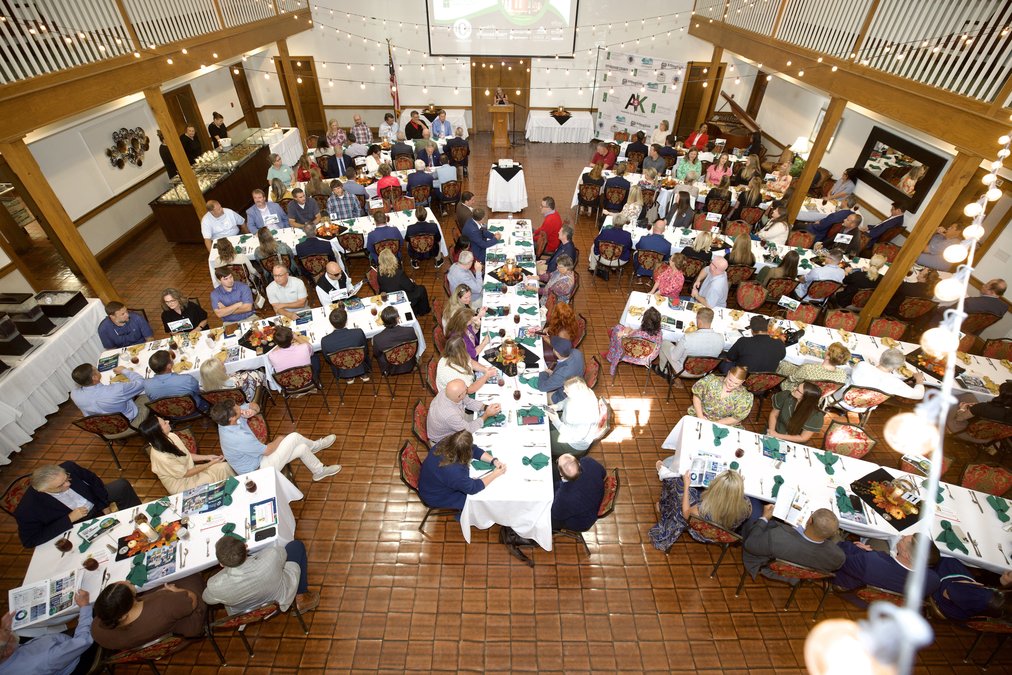
Four speakers outlined the county’s plans for growth, taxes, schools, economic development and Project Camellia Oct. 1 at the Effingham County Chamber of Commerce’s annual State of the County luncheon at the New Ebenezer Retreat Center, attended by local business leaders, government officials and elected officials.
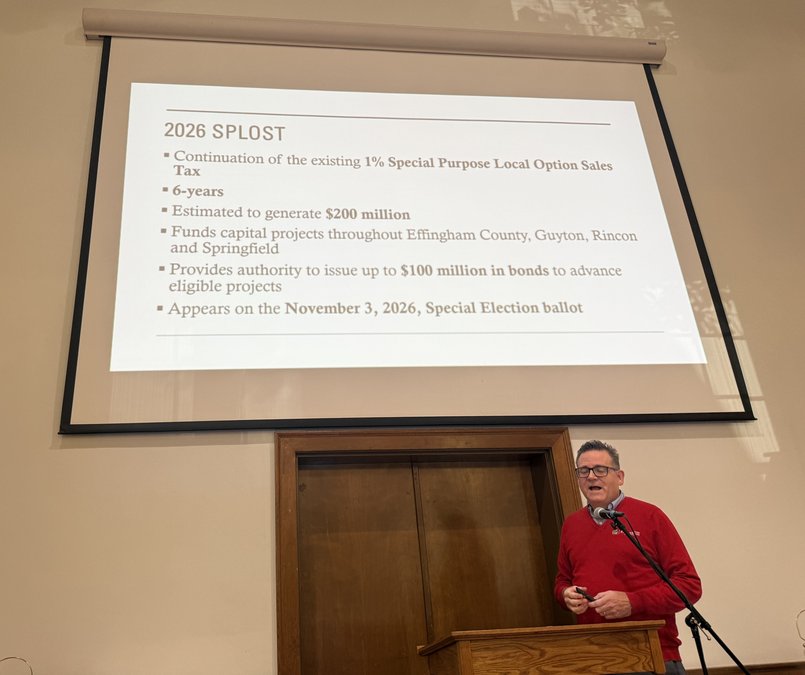
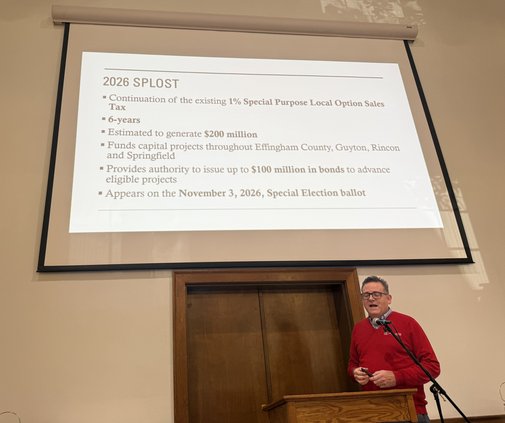
County Manager Tim Callanan detailed nearly $80 million in projects funded through the county’s 2022 SPLOST and outlined a proposed $200 million program for the next six years if voters approve a Nov. 3 referendum to continue the one-penny SPLOST.
Hank Evans, OpenAI’s leader for economic development and community engagement, detailed the company’s plans for electricity, water, noise, community investment and workforce development at the Camellia data center.
Effingham County School Superintendent Dr. Yancy Ford discussed the school system’s finances, academic progress and the financial challenges and opportunities created by the county’s growth.
Industrial Development Authority CEO Brandt Herndon outlined efforts to look beyond Project Camellia and develop a new long-term economic development strategy for Effingham County.
What 2022 SPLOST paid for
Callanan first looked back at what the county has accomplished with the 2022 SPLOST before outlining the much larger program voters will consider Nov. 3.
The 2022 SPLOST was approved as an $80 million, six-year program. But the county is collecting the money faster than expected and is on pace to reach the $80 million sooner than six years. The SPLOST ends when that $80 million has been collected, even if that happens before the six-year term is over.
Callanan said that had collections continued for the full six years, the county originally expected the program to bring in about $100 million. The proposed $200 million SPLOST would be twice that amount.
Among the projects funded by the 2022 SPLOST:
- Parks and recreation: The county renovated Baker Pond Community Park and Meldrim Memorial Park, with new pickleball courts, walking trails, playgrounds, pavilions and other improvements. Work also has been done at Pineora Park and Clyo Community Park. The first phase of the 650-acre Atlas Park includes trails, pavilions, a playground, boat launch and a 16-court pickleball facility.
- Public safety: SPLOST funds helped build a new EMS station in Rincon and an EMS training and maintenance facility near the intersection of Blue Jay Road and State Route 17. The Marlow Public Safety Building is under construction and will house a 24-hour fire station and EMS services, with additional space for the Sheriff's Office. The expanded Emergency Operations Center at the Clarence E. Morgan Complex also can serve as a shelter after a major storm.
- County facilities: The county is renovating the historic Springfield Central High School for the new elections offices, early voting, records storage and other government functions. The redevelopment also will include space for a senior center, addressing what Callanan described as a current facility that is “bursting at the seams.” The former Effingham Academy building on State Route 119 is being converted into a community services campus housing several agencies and organizations. The county also is renovating and expanding its animal shelter.
- Roads: The county has repaved 221 miles of roads — about 39% of the county system — and plans to repave another 28 miles. Callanan said the goal is to have the entire road system brought up to standard before the end of the decade.
- Technology and security: The county has upgraded its network infrastructure and added security improvements, including cameras at county buildings and parks.
“That is SPLOST of 2022, something that the citizens have entrusted us with, with an additional penny that we feel is necessary, to let you know that your money is being used for what we said it was going to be used for, and we’re showing results,” Callanan said.
What the next SPLOST could pay for
If voters approve the next SPLOST on Nov. 3, the county projects it could collect about $200 million over six years.
Callanan attributed the higher projection to updated estimates, Project Camellia and the expansion of Georgia Power, which he said is expected to become the county's largest source of sales-tax revenue.
The proposed program would set aside $50 million for countywide projects, with another $150 million distributed among the county and municipalities based on population.
Among the major projects outlined by Callanan:
- Atlas Park: Continue development of the 650-acre park, including additional recreation opportunities and access to the Ogeechee River for kayaks, canoes and paddleboards.
- Sand Hill Park: Complete a major renovation and expansion with a baseball field, eight multipurpose fields, courts, playgrounds, parking and a pavilion. The plan also includes land for a future gymnasium if sewer service becomes available.
- Clarence E. Morgan Complex: Add baseball and T-ball fields, improve parking, build what Callanan described as the county's largest all-access playground and potentially renovate the gymnasium.
- South county recreation: Develop an 18-acre site between Belmont Glen and New Haven with a gymnasium, perimeter trail, playgrounds and a dog park, while preserving space for a possible future aquatic center.
- Public safety: Build a regional public safety training center and a new Magistrate Court headquarters and courtroom near the Sheriff's Office.
- Health and libraries: Build a new Department of Health facility with roughly three times the space of the current building, construct a new Rincon library and potentially add another library on the south side of the county.
- Infrastructure: The proposal includes $30 million for roads, $6 million for fire equipment, $5 million for stormwater improvements and money for a land bank to acquire property for future parks and infrastructure.
The proposal also would allow the county to borrow against future SPLOST revenue to accelerate construction. Callanan said government borrowing rates are below current construction-cost inflation, allowing the county to get projects built sooner while potentially reducing costs.
A path to zero property taxes
Callanan also outlined the county’s longer-term plan to eliminate county homestead property taxes, known as Project Zero.
The tax reductions taking effect this year are the first major step toward that goal, made possible by the financial benefits of Project Camellia. Callanan said the next phase is planned for 2027 and will depend on a referendum voters will consider in November.
If voters approve the Local Homeowners Incentive Adjustment Grant referendum, approximately $13 million of the Effingham County Industrial Development Authority's payment from the Project Camellia deal would be used to eliminate county homestead property taxes beginning in 2027.
Using an example of a home with a taxable value of about $325,000, Callanan said the county property tax bill fell from about $2,600 last year to about $1,700 this year — a reduction of roughly 35%.
Callanan attributed the savings to the financial benefits of Project Camellia, which allowed the county, school system and Industrial Development Authority to reduce or suspend taxes and fees. The reductions included two mills from the school system, two mills suspended by the Industrial Development Authority, two mills from the Board of Commissioners, the fire fee being shifted into the property tax and the state's homestead credit.
“It is very rare that I see in my position when tax bills go out, you duck and cover,” Callanan said. “This year, it is very heartening to see folks are noticing the tax savings that they're getting.”
Project Camellia also is expected to affect future SPLOST collections. Callanan said the data center's full build-out could generate about $10 million in additional SPLOST revenue through its electricity usage.
Because Camellia is expected to become a major source of SPLOST revenue, Callanan said not approving the SPLOST would also reduce what OpenAI pays through the sales tax.
He cited Springfield's city manager Lauren Eargle as saying that not approving the SPLOST would amount to a significant tax break for OpenAI.
“Not passing SPLOST will actually be a very large tax break to our friends at OpenAI,” Callanan said.
Camellia and the community
Evans, OpenAI’s current point person for Project Camellia in Effingham County, said the company wants the project to become part of the community, not simply a massive data center located here.
“We’re really excited about the opportunity that we have in Effingham County to continue to build and develop our project here as we take into account community feedback,” Evans said. “...and how we’re making sure we’re being a good neighbor and a good community partner.”
Evans said being a good community partner is a priority for OpenAI as it develops projects across the country.
“We want to make sure that we’re bettering the communities where we’re operating,” he said.
Since Camellia was announced July 22, Evans said OpenAI has been working on several fronts:
- School meals: OpenAI announced an $80 million community investment fund when Project Camellia was unveiled. The first investment, $4.8 million, is providing free breakfast and lunch to more than 14,000 Effingham County students. The program began Sept. 8.
- Parks, nonprofits and residents: The next major investment from the $80 million fund will focus on parks and green spaces throughout Effingham County. OpenAI recently closed a community survey seeking input on that investment. Another portion of the fund will support existing nonprofit and community organizations. Evans also said OpenAI has received more than 100 submissions through its community feedback form, which remains active.
- Neighbors and existing businesses: OpenAI has canvassed more than 1,100 homes immediately adjacent to the project site, Evans said. More than 250 existing industries in the region also have submitted supplier-interest forms, covering potential work from construction through operations.
- Power: Camellia will allow Georgia Power to require the data center to reduce its electricity use by up to one-third during periods of severe grid stress. Evans said OpenAI would have 60 minutes to reduce its load.
“We’d be the first call for Georgia Power” if homes, schools, hospitals or others in the region are affected, he said. - Water and noise: The data center will recycle its cooling water in a closed system. Evans said its daily water needs would primarily be for sinks, toilets and kitchen operations. OpenAI also is studying existing noise levels around the property, and Evans said the results could affect the site's design.
- Workforce: OpenAI is working with local high schools, college and career academies, technical colleges, regional colleges and universities to develop training pathways for at least 400 full-time operational jobs planned at the facility.
Evans also announced plans to bring OpenAI Academy programs to Effingham County, with in-person classes expected to begin in coming months. The sessions could be tailored for existing industries, teachers, first responders and other local groups.
As he closed his remarks, Evans returned to the broader goal of becoming part of the community.
“We’re really excited to be a part of the fabric of Effingham,” he said.
Schools and growth
Ford said Effingham County’s schools remain a major reason families choose to live here, along with the county’s reputation for safety and its parks and recreation programs.
The school district is not experiencing rapid enrollment growth. Ford said that has allowed the district to open Creekside Elementary this year while keeping most existing schools in good shape.
The district does have concerns about Ebenezer Middle School, particularly its capacity and traffic. Ford said the district is looking at using 80 acres behind Ebenezer Middle and Elementary schools to create additional space for traffic and student drop-off.
He also highlighted the district’s academic performance.
“Our graduation rate continues to rise,” Ford said. “We’re pushing 95 percent. We’re 94.3 percent as a district.”
Springfield Elementary has been named a Title I Distinguished School for the second consecutive year. The recognition honors high-performing schools that serve a significant number of students from low-income families. Third-grade reading performance is 82%, while fifth-grade reading performance is 87%, Ford said.
Camellia reshapes school funding
Ford said the biggest change facing the school district may not be enrollment. It could be the way the county’s growing tax base affects school funding.
For decades, Effingham has been largely a residential community, he said, leaving homeowners to carry much of the local tax burden.
The $20 billion Project Camellia changes that equation.
Ford said the school district receives about $18 million a year from the state based in part on the relative wealth of the county and its students. A rapid increase in Effingham’s tax base could reduce that state money.
The district also faces another state calculation that determines how much local money it must contribute to schools.
That matters to local taxpayers because a reduction in state funding could leave the school district responsible for making up more of the difference with local dollars.
Camellia's 15-year property tax break gives the school system time to prepare for those changes. The project will not immediately add its full potential tax value to the county's tax base, giving the district time to adjust as other industrial, commercial and residential development expands the tax base.
IDA plans for what’s next
Herndon, CEO of the ECIDA, said the county’s existing industries remain a major part of the local economy even as Project Camellia brings new attention to economic development.
Those industries support more than 4,200 jobs and buy more than $165 million in goods and services from Effingham businesses each year, Herndon said.
Now, the IDA is looking at what comes next.
Earlier this year, the authority began a strategic planning process to help determine where Effingham’s economy should go next. More than 750 residents responded to a survey, while the IDA also gathered input from county and school officials, city governments, the health care system, the Chamber and other community groups.
Herndon said the authority is reviewing that feedback along with economic-development programs used in other communities to identify ideas that may make sense for Effingham.
The plan will look beyond attracting industry to areas such as entrepreneurship, workforce development, infrastructure and communication.
“More than anything, this process is about making sure we are intentional about what comes next, and using this moment to help shape the next chapter of economic development in Effingham County,” Herndon said.
The IDA expects to release its strategic plan in late 2026 or early 2027.
State of the cities
Susan Kraut, president and CEO of the Effingham County Chamber of Commerce, announced a new event focused on the county’s cities.
Kraut announced that the Chamber will soon launch State of the Cities, a sister program to the State of the County luncheon.
She said the new event will give mayors and other municipal leaders more time to talk about what is happening in their communities.
“You are going to soon hear about State of the Cities, which will be the sister program to today’s State of the County,” Kraut said.