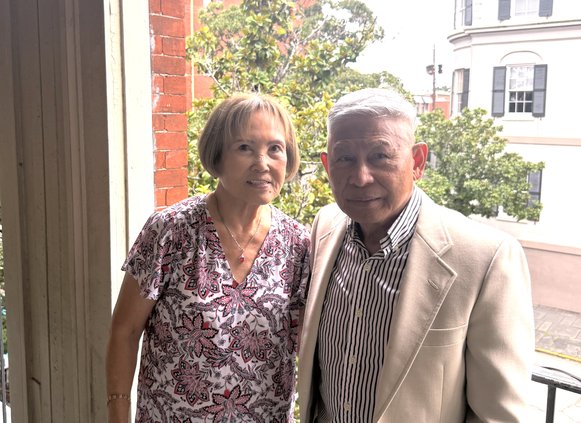
SPRINGFIELD, Ga. — In the early years of Dr. Romualdo Laygo’s Effingham County practice, there was a simple way to find the doctor.
Look for his car.
If his maroon Mercedes-Benz 300D was outside his Springfield office, Laygo was in. If it was at the hospital, he was working. And if a patient needed to see him, an appointment wasn't always necessary.
They just stopped by.
That was medicine in Effingham County in 1977, when Laygo arrived at a small hospital in Springfield with only a handful of doctors.
Nearly 50 years later, Laygo is retiring from the practice he started in 1977. His Effingham County career represents nearly five decades of medicine, but his medical career began about 60 years ago, in the Philippines and New York.
Effingham Health System estimates he has treated about 50,000 patients during his career, with his care spanning as many as five generations of Effingham families.
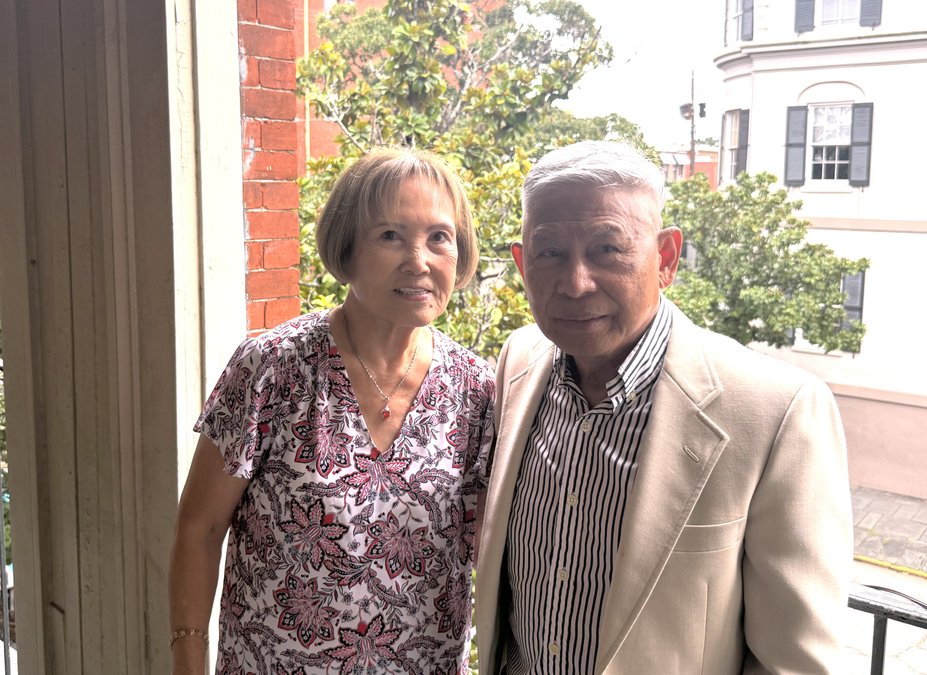
For this interview about his retirement, he arrived in Savannah with his wife, Marina, of more than 60 years at his side.
And a Bible in his hand.
At 90, Laygo is animated and expressive. He points toward the ceiling to make a point and leans forward when a story gets good. His hands are small and delicate. Even as he talks, they move with the precision of a surgeon’s hands, punctuating his stories and underscoring his words. When he smiles, his eyes nearly disappear behind the squint. One moment he is laughing; the next, he is leaning in to make a serious point. His good humor is infectious.
Laygo has plenty of stories. He shared photos on his phone from places he and Marina have traveled around the world. He speaks knowledgeably about religious art, loves adventure and horror movies, and plays pickleball three times a week. He and Marina also attend prayer group meetings and Sunday Mass at St. Frances Cabrini Catholic Church.
When asked what he will miss most about retirement, Laygo didn't mention the surgeries.
He didn't mention the hospital.
He didn't mention the number of people he treated.
“I will miss talking to my patients,” he said.
That answer came quickly.
He often asked patients what they did for a living. He wanted to know about their families, where they had been and what they had seen.
“I learn from them,” he said.
For Laygo, every patient had a story. And he couldn’t wait to hear them.
A long road home
Laygo's journey to Effingham County took more than a decade and several thousand miles.
He graduated from medical school in the Philippines in 1962 and spent about a year practicing in Santa Maria, a city in the province of Laguna. After passing the Educational Commission for Foreign Medical Graduates exam, he came to the United States on Jan. 5, 1965.
New York was his first stop.
He completed a rotating internship in Bronxville, a village in Westchester County north of New York City, then began his general surgery residency at New York Infirmary in Manhattan. During his residency, he also trained in trauma at Bellevue Hospital and cardiovascular surgery at New York University.
His training continued in New Brunswick, New Jersey, where he completed three more years of general surgery training and served as chief resident at St. Peter's General Hospital.
By 1973, Laygo was practicing in Oceanside, Long Island, and working with five hospitals.
It was a demanding life.
Maybe too demanding.
One hospital was less than five miles away, Laygo said, but traffic could turn the trip into an hour.
“I was always in a hurry,” he said.
The hurry had consequences.
“I had two accidents and I had too many speeding tickets,” he said.
He also had parking tickets from Albany, New York, and had been warned his license could be suspended if he got another one.
For Laygo, the math wasn't working anymore.
He realized the pace was taking over his life.
Then there was the malpractice insurance.
“I was working just to pay for malpractice,” he said.
A friend, Dr. Chen Shih, who was practicing in Hinesville, told him Effingham County was looking for a surgeon.
Laygo wasn't immediately sold.
He was living in Oceanside, a big city, and moving his family to rural Georgia was a big change. A malpractice insurance salesman added another concern, warning him about segregation in rural Georgia and questioning how his children, who were neither white nor Black, would fare.
Laygo hesitated.
Then he called Shih.
The answer was simple.
“Everything is OK. Come and visit.”
So they did.
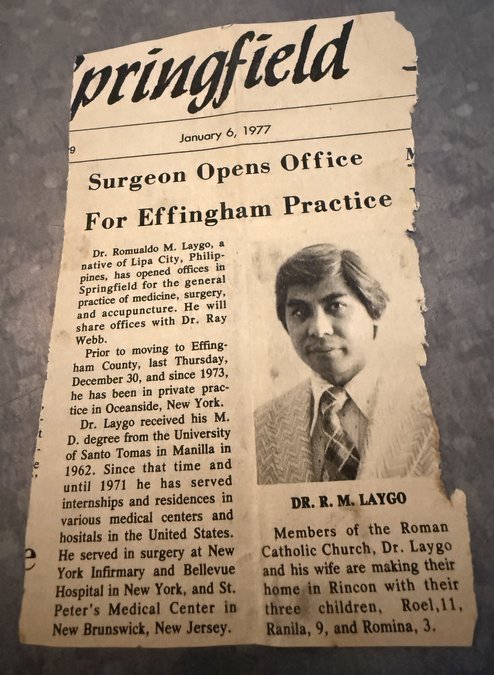
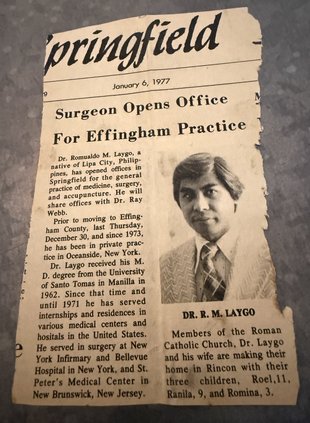
Laygo, Marina and their young family moved to Effingham County on Dec. 30, 1976.
It was their wedding anniversary.
Five days later, on Jan. 3, 1977, he opened his office.
He stayed.
A different calling
Laygo's path to medicine wasn't exactly his idea.
He wanted to be a lawyer.
His father, a goldsmith who later became a farmer, had a different plan. Laygo's younger sister would become a pharmacist, and Laygo would become a doctor. Their offices would be next door to each other.
“That was his dream,” Laygo said. “We will be in the same place.”
His father's plan won out. Laygo became a doctor, and his sister became a pharmacist.
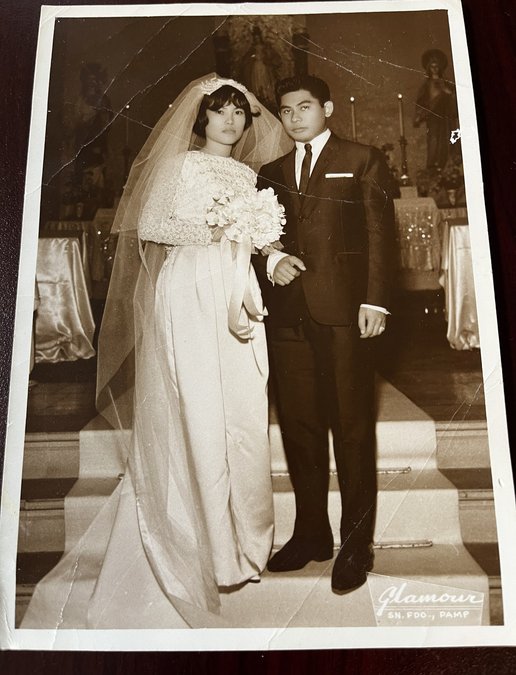
Marina entered the story in a much more literal way.
They met in Manila, where their homes were next door to each other — separated by a wall.
“We were neighbors,” Laygo said.
They also attended the University of Santo Tomas, a private Catholic university in Manila.
More than six decades later, Marina is still beside him.
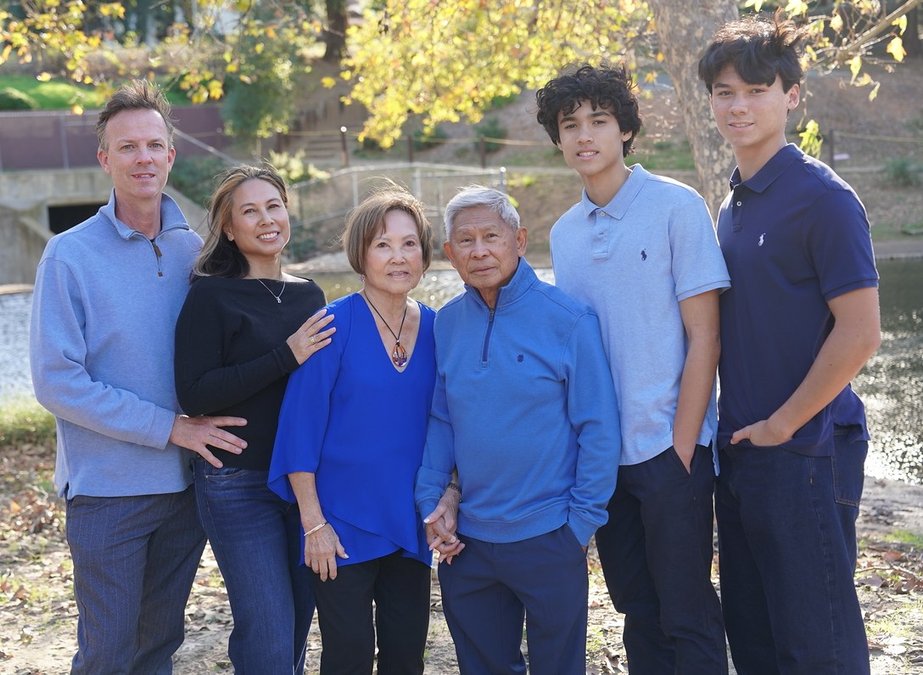
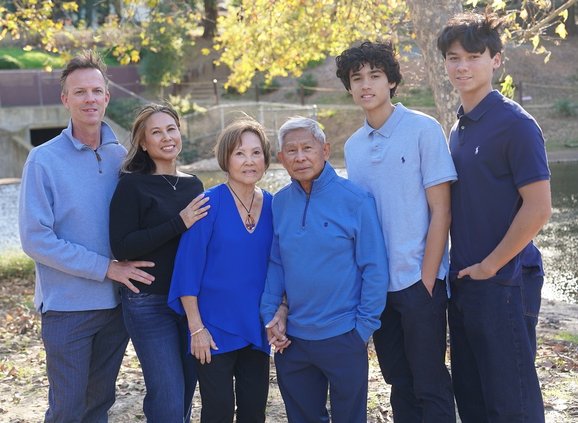
They have been married for 61 years and will celebrate their 62nd anniversary in December. Along the way, they raised three children and now have 10 grandchildren.
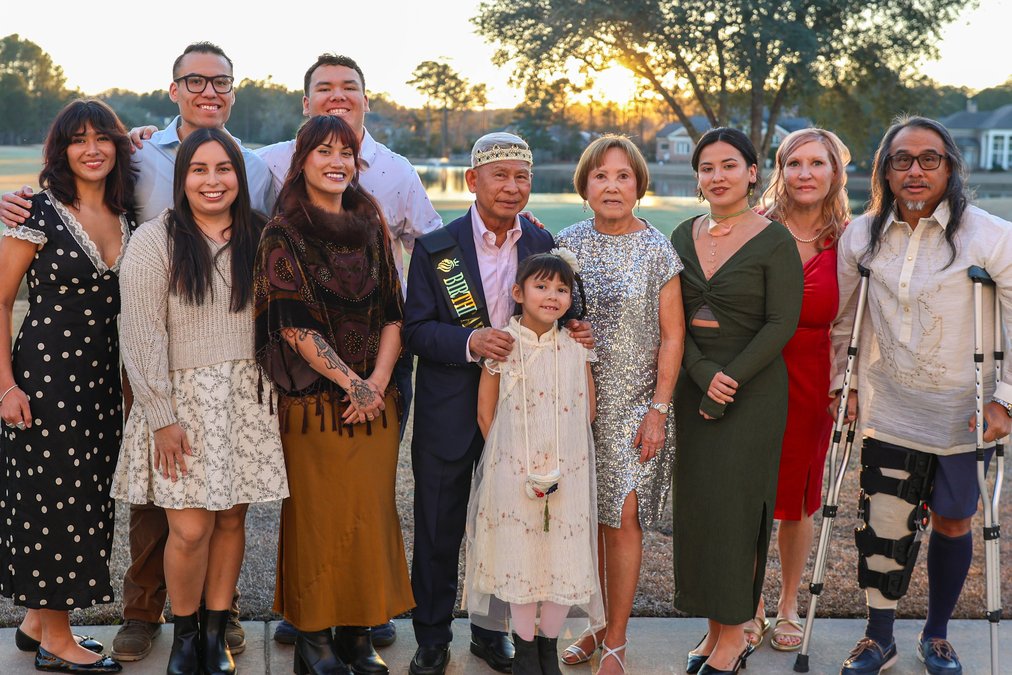
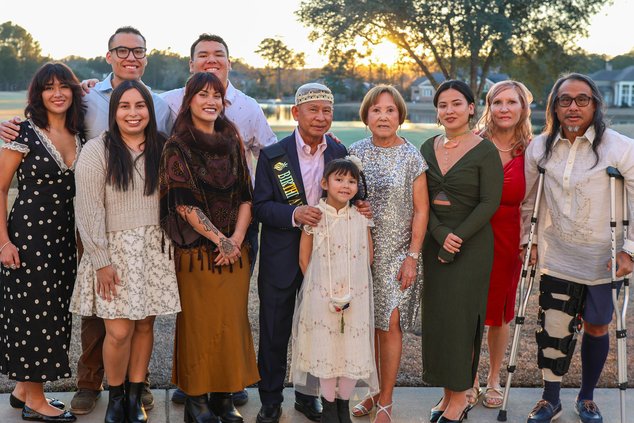
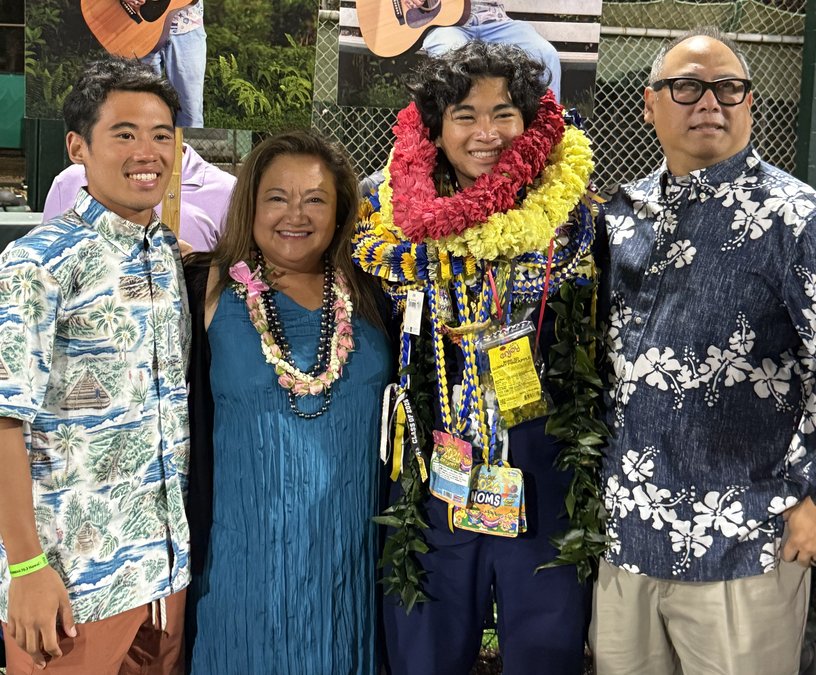
Their oldest son, Roel, is an internal medicine physician in Savannah. He and his younger brother, Ranilo, both attended Effingham Academy, the private school that closed in 1985. Ranilo went on to earn a doctorate in psychology and now lives in Honolulu.
Ranilo remembers his father as “always very jovial.”
“He always has had a great sense of humor, you know, probably was doing the dad joke before the dad joke became popular,” Ranilo said.
Their daughter, Romina, graduated from Effingham County High School before earning a degree from Syracuse University's Newhouse School of Communications. She worked for Disney before becoming a mother and private Pilates instructor in California.
When Romina was in high school, she wrote an essay about her father. Her subject wasn't medicine. It was a wall.
Laygo's office in Springfield had once had separate waiting rooms for Black and white patients. The wall came down around the time Romina was in high school, creating one waiting room. That change stayed with her — enough that she wrote about it in her essay.
The physical barrier was gone, but some old habits remained. Some longtime patients still entered through the doors they had always used.
For Romina, the change meant more than remodeling an office.
“My dad, like, literally and figuratively broke down these walls,” she said.
Laygo also helped bring Dr. Josefina Tan to Effingham County as the county's first woman anesthesiologist. For years, the Tans and Laygos were the only two Filipino families in the county, and the families became close, Romina said.
No such thing as off-duty
The fledgling Effingham hospital Laygo joined was small — and there wasn't much room for a doctor to say, “That's not my job.”
There were only about four doctors, and they also shared responsibility for the emergency room.
Laygo was a private practitioner, not a hospital employee. The hospital rented space for his office during his first year, guaranteed his income and provided two employees. After that, he took on the office expenses himself.
Then he went to work.
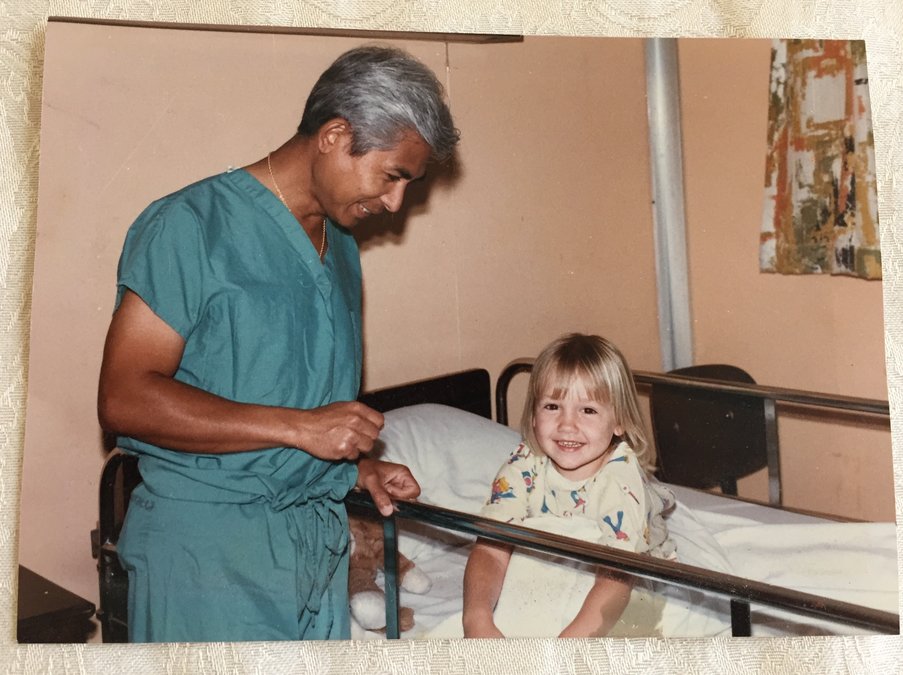
He performed surgery at the hospital, covered the ER and saw patients in his office. On some days, he could have 10 to 15 inpatients while still seeing office patients and responding to emergencies.
There was no real dividing line between the office and the hospital.
At his children's sporting events, Laygo might have been there as a dad, but he was still on duty.
If a player went down, he might rise from the stands before anyone asked. His children knew him as the doctor who wrapped a sprained ankle, treated their injuries and even used acupuncture to get them back on the court, field or stage.
“He was always kind of the de facto doctor on site,” Romina said.
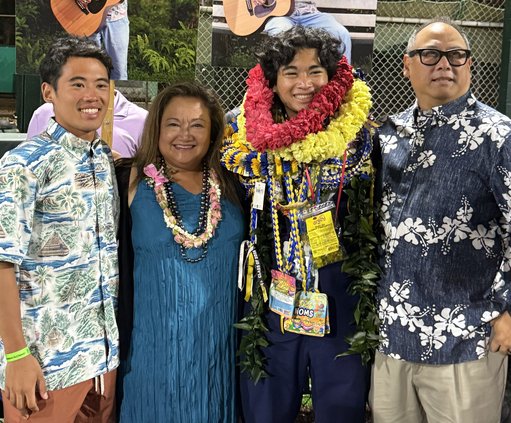
Ranilo remembers another side of that same commitment: His father showed up.
“He always made time for us,” Ranilo said.
Basketball games. Football games. Travel games outside Springfield. Despite the long nights and demanding schedule, Laygo was there in the stands.
Once, during a soccer game, one of Ranilo's friends was injured going for a header. Laygo left the game, put the injured player in his personal vehicle and drove him to the hospital to make sure he was OK.
Being the doctor was simply part of who Laygo was. For more than 30 years, he was Effingham County's only surgeon.
As a general surgeon, he did appendectomies, hernia repairs, gallbladder and abdominal surgeries, thyroid procedures, tonsillectomies, hysterectomies and more.
There was one thing he wouldn't do.
“I told them when I came in,” he said. “I don't deliver babies.”
About 15 years ago, he stopped doing major surgery. These days, his surgical work is limited to minor procedures.
Cysts. Skin cancer. Circumcisions.
Five generations deep
For Laygo, patients were never just names on a chart.
Some stayed with him for 35 years. Others returned years later, picking up conversations and relationships that had begun decades earlier.
One patient hugged him when they said goodbye.
Another cried.
Laygo said he will miss the nurses, employees and other people he worked with over the years.
But mostly, he will miss the conversations.
He often asked patients what they did for a living. Truck drivers especially fascinated him. He wanted to know where they had traveled and what they had seen.
It was another way of learning.
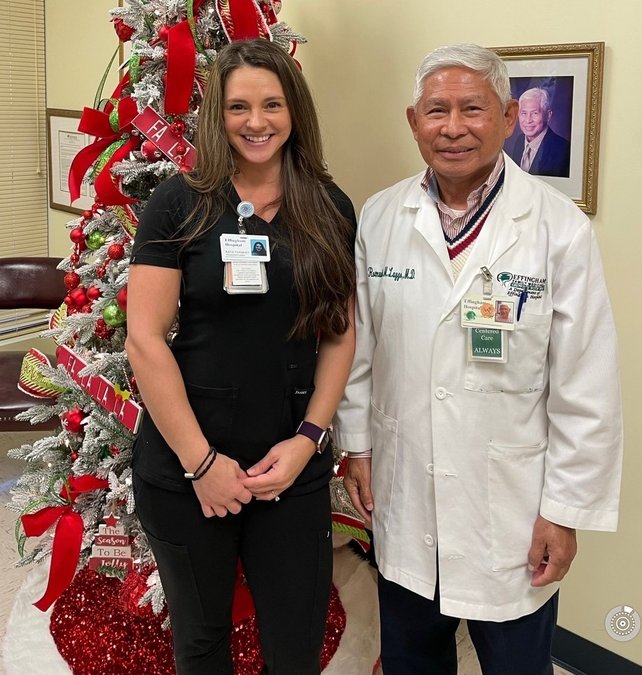
Katie Rowse, who lives in Springfield, saw that side of Laygo every day.
For eight years, from 2018 until January 2026, Rowse worked alongside Laygo as his scribe.
“I followed him everywhere,” Rowse said.
Every patient Laygo saw, Rowse was there. He made her part of the conversations and talked through his decisions with her.
People around the office called her Laygo's "right-hand man."
About five years into working with Laygo, Rowse decided to become a nurse.
Laygo encouraged her.
“He was like, you need to do it. You need to do it,” Rowse said.
She did.
Rowse spent her final two years with Laygo in nursing school. She left his office in January to finish her final semester and graduated in July.
She now works as a nurse at Candler Hospital in Savannah.
Her years with Laygo gave her more than medical experience.
She watched how he treated people.
“He absolutely was,” Rowse said when asked if Laygo was a good listener. “He remembers everything, you know. I mean, he knows all of his patients by name. He knows their grandparents, like he knows everything. He doesn't forget.”
Effingham Health System President and CEO Dr. Fran Witt said Laygo's relationships with patients are an important part of his legacy.
“Dr. Laygo has earned the trust of generations of families in our community. Those relationships are such a special part of his legacy — he’s not just their doctor, but someone who has been there for them through the years,” Witt said.
It’s how one doctor became part of five generations of Effingham families.
Going home to give back
Laygo never really left the Philippines behind.
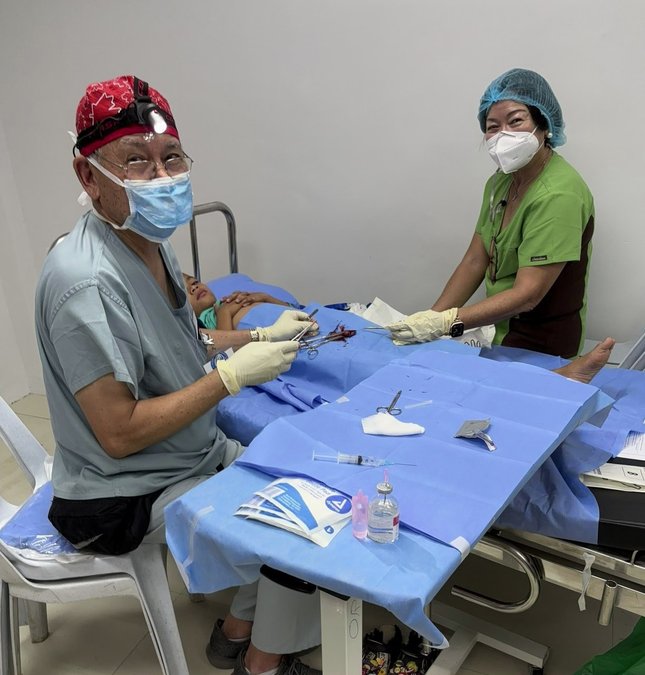
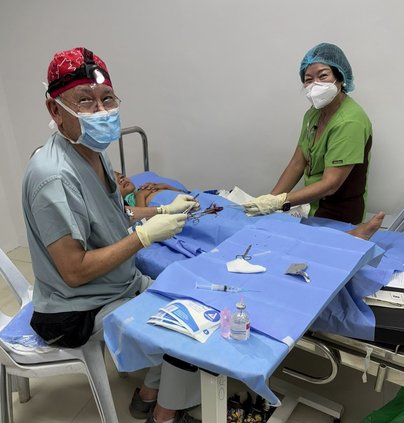
Around 2007, he began returning home for medical missions, bringing the skills he had spent decades developing in the United States back to the country where he first learned to be a doctor.
He went almost every year, except during the COVID-19 pandemic.
The missions were organized through the Society of Philippine Surgeons in America, where Laygo once served as president. He performed general surgery, but getting a medical team into a community took more than surgeons.
Equipment had to get there, too.
In some communities, a mayor, representative or governor sponsored the mission, providing a place to work along with lodging and meals. Even then, getting the equipment through customs and to the right place could be a challenge.
Despite the obstacles, Laygo kept going back.
He still doesn't sit still
Laygo has never been one to slow down.
Tennis was a family affair. Laygo played with his children, and Ranilo never stopped playing.
A few years ago, when Laygo was in his mid-80s, he joined Ranilo and his teammates in Hawaii for a two-hour tennis lesson. His teammates kept asking if he needed a break.
He didn't.
Afterward, they were amazed.
“Oh my God, your dad,” Ranilo remembers them saying.
Laygo eventually stopped playing tennis regularly for a simple reason: He had outlasted many of the people he used to play against.
Now he plays pickleball several times a week.
He and Marina travel about twice a year, recently visiting Iceland, Ireland and Norway in hopes of seeing the Northern Lights.
The weather had other plans.
They didn't see the lights, and a planned trip to Paris was canceled. But the travel isn't stopping. They are planning a trip to Morocco in November.
There will be more pickleball, more travel and plenty to keep Laygo moving.
The secret
At 90, Laygo is still being asked the question that comes with a long life:
What's the secret to longevity?
Laygo paused and pointed toward the heavens.
He talked about the things older people say when asked the same question on Facebook — eating rice, drinking vodka, eating vegetables, following one habit or another.
“There is no secret,” he said.
“I always tell my patients, ‘What is the secret? It's because our Creator let you stay.’”
Laygo paused.
“It is what He desires.”
If God lets you live to 100, Laygo said, “you will live to 100.”
Laygo doesn't dismiss healthy habits. He believes in doing what you can to take care of yourself.
But ultimately, he said, longevity isn't something you can engineer.
“There is no secret,” he said. “Whatever you do, it's okay. You try to do what's healthy.”
“Ultimately, it's somebody out there.”
The doctor who arrived in Effingham County nearly 50 years ago with a new practice, a young family and a new community to call home could not have known how many lives he would touch or that his name would become part of the story of generations of Effingham families.
For nearly five decades, he has believed that answer was never entirely his to decide.
He simply looked up.