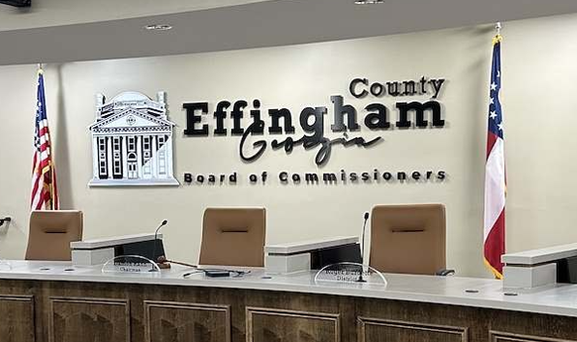
SPRINGFIELD, Ga. — Effingham County commissioners voted unanimously Tuesday to advance an update of the county’s zoning ordinance, but much of the discussion focused on a question that has become increasingly important to residents: What rules will govern data centers in Effingham County?
Several residents urged commissioners to require data centers to receive special approval before they can be built, rather than allowing them automatically in certain industrial zoning districts. They also questioned how the county’s existing rules were developed and whether residents had enough notice and opportunity to weigh in.
Tuesday’s vote was the first step in the process. Commissioners approved the ordinance and an updated zoning map on first reading, with a second reading scheduled for Nov. 3. The additional time will allow officials to review residents’ concerns and consider possible changes.
The ordinance update is largely intended to clean up conflicting language in the county’s existing zoning rules and incorporate zoning changes commissioners have already approved, County Manager Tim Callanan said.
One change expands the Planning Board’s role in reviewing certain development requests. Conditional-use applications in commercial and industrial zoning districts will go before the Planning Board for a public hearing and recommendation before commissioners consider them.
“One thing that we did change at the request of the board was that ... we also include the applications for conditional uses in commercial and in industrial,” Callanan said.
Most of the other revisions clarify language related to the Planning Board’s responsibilities, he said.
But because commissioners are readopting the ordinance as a whole, residents said the vote also brings the county’s existing data center rules back into focus.
Residents’ calls for greater transparency stem in part from the way Project Camellia, OpenAI’s proposed data center campus, came to light. The project was announced July 22, and OpenAI hosted a public open house the following day.
Residents questioned why they had not been informed earlier, saying key decisions appeared to have been made before the public learned about the plans. The Herald and other news organizations have reported on the negotiations, agreements and development decisions that preceded the announcement.
The lack of public input before the announcement has since become a central concern for residents seeking stronger safeguards and a greater voice in future data center proposals.
What the zoning changes mean
Zoning rules determine how property can be used and what types of development are allowed in different parts of the county.
Some uses are permitted automatically when a property meets applicable zoning requirements. Others require conditional-use approval, which gives county officials an additional opportunity to review a proposed use through a process that can include a public hearing.
Residents who spoke Tuesday said data centers should fall into the second category across industrial zoning districts. That would give the county another opportunity to review data center proposals before deciding whether to approve them.
Residents question data center rules
Lyndsay Smith, a licensed real estate agent in Effingham County, previously served on both the Planning Board and the Development Services Steering Committee, which reviewed the county’s development regulations and zoning classifications.
Smith resigned from the Planning Board effective July 31, a week after the OpenAI announcement. She later said she left because she did not know a data center was being planned, raising questions about whether data centers had been adequately discussed during the county’s review of its zoning rules.
At Tuesday’s meeting, Smith said data centers should require conditional-use approval and a public hearing rather than be allowed by right.
“They should require conditional use and a public hearing, such as landfills and adult businesses already do in our county,” she said.
Smith also raised concerns about the local housing market, citing figures she said showed a sharper decline in home sales in Effingham County than in neighboring counties.
She told commissioners that home sales in Effingham were down 37% compared with September 2025 and had declined 32% since July. By comparison, she said sales in Chatham County were down 5% over the year, while Bryan County saw a 2% decline.
“When neighboring counties are only seeing a minimal decline in sales, I think it's time to stop dismissing the concerns of your residents and start taking our concerns a little more serious,” Smith said.
Her comparison came as residents urged commissioners to take a closer look at the potential effects of industrial development and strengthen the county’s safeguards. Smith did not establish a direct link between data center development and the reported decline in home sales.
Raymond Carver also urged commissioners to slow the process until they had enough time to review the proposed changes and consider protections for industrial development.
Carver is one of three Effingham County residents who sued the county over a zoning change approved Aug. 4 that allows data centers in certain industrial areas. The lawsuit argues the county did not follow required procedures, including holding public hearings, and asks a judge to overturn the change.
“I oppose adopting anything new until we can sit down and have all of this read through,” Carver said, noting that commissioners and residents were being asked to work through more than 800 pages of information without adequate time or opportunity to review it before speaking.
He called for additional safeguards in the county’s industrial zoning rules.
“I do oppose changing anything until we can bring forth any type of guardrails or ordinances or stipulations inside of each and every zoning opportunity for industrial, especially because we don’t want to be blindsided,” Carver said. “We don’t want to go through this over and over again. We genuinely just want to be able to have the opportunity to have a voice in what’s going on.”
Debate over public input
In response to Carver’s concerns, Commissioner Jamie DeLoach asked Callanan how many workshops had been held over the years as the county reviewed its zoning regulations.
Callanan said there had been multiple workshops, but attendance had been limited. DeLoach emphasized that the zoning changes had been the subject of previous meetings and had not simply appeared without public discussion.
Smith disputed the suggestion that residents’ concerns stemmed from failing to attend those meetings.
She said she attended most of the steering committee’s meetings but never saw data centers listed as a permitted use in the county’s light industrial zoning rules in the version of the table circulated to committee members. She questioned when the designation was added.
Callanan traced the issue to changes made before and during the county’s zoning review. The steering committee recommended requiring conditional-use approval for data centers in light industrial districts while retaining permitted-use status in heavy industrial districts. In December 2025, commissioners approved a change to correct the table of permitted uses and align it with existing zoning language. Callanan said the steering committee had not specifically addressed the light industrial designation at issue because it was not listed in the table at the time.
Residents question public notice
The timeline did not resolve residents’ questions about how the zoning language changed or whether the public had adequate notice before commissioners considered the December 2025 amendment.
John Smith, who lives in Belmont Glen, a neighborhood near the planned OpenAI site at Savannah Gateway Industrial Hub, questioned whether the public had received proper notice before commissioners considered the change involving data centers and industrial zoning.
He said the meeting was advertised in the Herald on Dec. 3, the day after the public hearing, leaving residents without an opportunity to review the agenda and attend. Chairman Damon Rahn said the agenda had also been posted on the county website.
“The website doesn’t meet the legal requirements, though,” John Smith said.
Commissioners said they would look into the public notice discrepancy.
Commissioners consider more protections
Commissioners discussed two possible steps: placing a temporary hold, or moratorium, on future data center development and reviewing whether data centers should require conditional-use approval across industrial zoning districts.
Manjusha Sheobaran, another Belmont Glen resident, urged commissioners to establish a moratorium until additional regulations were in place. She also called for data centers to require conditional-use approval across industrial districts.
“I think you guys have mentioned moratoriums and you've mentioned ordinances that need to be put into place,” Sheobaran said. “And until those are done, or until the ordinances are put into place, I do agree that the moratorium needs to be there. But I also think that the TPU should be updated to be conditional use for data centers across the board, because you don't have laws, you don't have rules, and those are necessary in order for us to move forward with this.”
Rahn asked whether changing the zoning requirements now could affect Project Camellia. The county’s lawyer said the answer would depend on the existing zoning and whether the project had established legal rights under those rules.
Commissioners weigh moratorium
Commissioner Roger Burdette said county officials had followed the proper process in developing the zoning rules, noting that data centers were not a major public concern when the changes were initially considered.
“We have done things properly,” Burdette said. He said the steering committee understood the work underway and that data centers had not yet become the prominent issue they are today. At the time, he said, officials had no knowledge of a specific data center proposal, so he did not fault residents or committee members for not focusing on the issue.
“Everybody is looking for somebody to blame here, and sometimes there’s not,” he said.
Burdette said he supported Commissioner Beth Helmly’s suggestion of a moratorium on future data center proposals to avoid similar disputes. He said Project Camellia would have to demonstrate that it could meet expectations through its actions, adding that he believed the company was willing to do so.
He also said the county needed to move forward with the existing ordinance while working to improve its protections.
Helmly said the county needed to clean up its zoning rules and pledged to seriously consider requiring conditional-use approval for data centers across industrial zoning districts. She also supported placing a moratorium on the agenda as soon as possible, saying it could ease residents’ concerns about future industrial properties being used for data centers.
Helmly said the additional two weeks before the ordinance’s second reading would give residents time to email commissioners with questions and suggest changes.
Commissioners are scheduled to consider the ordinance again Nov. 3. In the meantime, Helmly said she wants the board to address a possible moratorium on future data center development as soon as possible.