RINCON, Ga. — OpenAI plans to build a $20 billion, 1,400-acre data center campus in Effingham County, a project county leaders say could eliminate county homestead property taxes, create up to 1,000 permanent jobs and become one of the largest private economic development investments in coastal Georgia history.
Dubbed “Project Camellia,” the proposal marks the first time OpenAI has built its own data center campus in Georgia. While the company already purchases computing capacity from existing facilities in the state, the Effingham County project would represent a ground-up investment by the artificial intelligence research and deployment company.
OpenAI is an Artificial Intelligence research and deployment company. It’s the company behind ChatGPT, an advanced AI chatbot and virtual assistant, which receives more than 2 billion prompts from global users per day.
Before construction begins in Effingham County, however, OpenAI is inviting residents to learn more about the proposal during a public open house Thursday from 6 to 8 p.m. at the Effingham County College and Career Academy. Company officials, contractors and project partners will answer questions, discuss the project and gather public feedback.
“We have to earn the trust, we have to earn the right to build this,” said Chris Lehane, OpenAI’s chief policy officer. “Part of earning that right and earning that trust is to actually hear back from people.”
Project could reshape county finances
County officials say the project has the potential to reshape Effingham County’s financial future.
The ECIDA Board approved an incentive package, during its July meeting, Tuesday, which provides OpenAI with a 50% property tax abatement for 15 years – with the company locked into the 2026 millage rate for those 15 years.
ECIDA communications officials said this means the company will “not benefit from any future millage rollbacks facilitated by the investment.” This agreement allows the county and school system to receive more tax revenue than they would without the abatement.
OpenAI is expected to become the county’s largest taxpayer, generating hundreds of millions of dollars in state and local tax revenue while accelerating Effingham County’s “Project Zero” initiative to eliminate county homestead property taxes.
“This project has the potential to change the financial future of Effingham County in ways that will benefit our citizens for generations,” Effingham County Manager Tim Callanan said. “It has the potential to become the catalyst for Project Zero, our commitment to eliminate county homestead property taxes. The revenue generated by this project will accelerate that vision and make Project Zero a reality as early as next year.”
The project is also expected to create thousands of construction jobs over several years. OpenAI officials said permanent employment would begin at about 400 workers and grow to as many as 1,000 as additional phases of the campus are completed.
Why Effingham?
The announcement follows months of discussions between OpenAI, state officials, Georgia Power and local leaders as the company searched for a location capable of supporting a large-scale artificial intelligence computing campus.
Georgia has become one of the nation’s fastest-growing markets for data center development, with the Atlanta region serving as a major hub for cloud computing and artificial intelligence infrastructure. There are between 150 and 200 data centers operating across the state today.
OpenAI representatives met with Gov. Brian Kemp in May to discuss the company’s plans for Georgia and explain why the state was being considered for future infrastructure investments.
According to a one-page meeting briefing memo obtained by The Current GA, the purpose of the meeting was to “brief the governor on OpenAI’s activity in the state of Georgia,” including potential locations, jobs, investment commitments and the company’s strategy and timeline.
OpenAI has already launched what Lehane described as “focused projects” in Abilene, Texas; Port Washington, Wisconsin; and Saline Township, Michigan.
Lehane said OpenAI began developing a relationship with Georgia Power while working on projects elsewhere, and that relationship helped lead the company to evaluate Effingham County as a potential site.
Georgia Power received approval from the Georgia Public Service Commission in December 2025 for a nearly 10-gigawatt expansion of its generating capacity. About 80% of that additional output is expected to support current and future data center demand.
OpenAI has contracted with Georgia Power for 3.2 gigawatts of power for Project Camellia, delivered across a roughly four-year period. A traditional hyperscale data center requires about 100 megawatts of power — one gigawatt is about 1,000 megawatts, the equivalent to powering a mid-sized city, according to International Business Machines Corporation, a New York-based technology and consulting company.
“We went on the ground, spent time with local officials … to see if this is not only a site that would work from a technical capacity … or how we would generate and build out that infrastructure, but is this a place where we could work in a responsible, productive, constructive way with the local community,” Lehane said.
“This is the first where we’re going in at the ground level and building it, designing it and working to be part of the community.”
OpenAI officials met with Effingham County staff and elected officials, representatives from the Effingham County Industrial Development Authority and leaders from the Effingham County School District before moving forward with the project.
“After personally visiting several data centers to ensure this project would be a net-positive partner, I am confident OpenAI is the right fit for Effingham,” Effingham County School District Superintendent Yancy Ford said. “This partnership will successfully lower property taxes for residents while investing in teacher and staff resources and salaries and expanding opportunities for our students.”
Building for artificial intelligence
Lehane described the project as a long-term investment built around a “full stack” design that will allow major computing components to be replaced and upgraded as technology evolves.
He called the build-out of Project Camellia “fungible,” meaning the facility would be able to be updated in the future as technology evolves and innovates, allowing for long-term usage.
OpenAI officials said the project is designed to become a permanent part of the community rather than simply another industrial development.
“We’re trying to think about this in a holistic way,” Lehane said. “At the center of that is making sure that this thing is going to be something that does have long-term economic value for the community.”
Power, water and community concerns
Data center projects have expanded rapidly across the country as demand for artificial intelligence and cloud computing has grown. But the developments have also drawn opposition in some communities over concerns about electricity demand, water use, noise and the impact of large industrial facilities on surrounding neighborhoods.
In neighboring Bulloch County, officials are considering a ban on new data center developments amid concerns about the impact of large-scale facilities on electricity demand, water resources and surrounding communities.
OpenAI officials said the company recognizes residents will have questions about the project’s potential impacts and designed the Effingham County campus with those concerns in mind.
The company said it will pay the full cost of the electrical infrastructure needed to serve the campus. Under Georgia Public Service Commission rules, those costs cannot be passed on to existing Georgia Power customers.
OpenAI officials said the project is designed to reduce electricity consumption during periods of peak demand to help protect the reliability of the power grid.
“Also, this project will be one of the first data centers designed to proactively reduce its power consumption before residential customers are impacted during periods of high demand, so we can meaningfully support the reliability of Georgia Power’s electric system and support our neighbors,” the company said in a statement.
Company officials said exact water usage is unknown as the project has not yet fully been designed, but the campus will use a closed-loop water system that continually recirculates water rather than drawing large volumes from local water supplies.
According to OpenAI, ongoing water use will primarily be for domestic purposes such as restrooms, kitchens, sanitation and maintenance and will be comparable to an office building with a similar number of employees.
The company also pledged to comply with all applicable federal, state and local environmental regulations.
Jobs and community investment
OpenAI said building the facility is expected to create thousands of construction jobs for electricians, equipment operators, mechanics, technicians and other skilled tradespeople needed to build the campus and its power, electrical, cooling and mechanical systems.
While the site is committed to begin with at least 400 permanent jobs, officials said it’s expected to grow over 1,000 permanent employees with roles like site leadership, operations, electrical and mechanical maintenance, computing systems, security and data safety.
In addition to construction and permanent jobs, OpenAI announced a series of commitments aimed at supporting the community over the long term.
Those commitments include investments in local infrastructure, workforce development partnerships with the Effingham County School District, internship and career awareness programs for students, collaboration with local colleges and technical schools, and opportunities for local contractors and suppliers during both construction and operations.
The company also plans to establish a community investment fund worth $80 million to support local priorities identified by residents.
Across Georgia, OpenAI said it will provide up to $71 million in Codex credits for students attending colleges, universities and technical schools. Eligible students will receive $100 in credits through their ChatGPT accounts to use OpenAI’s coding assistant.
To provide accountability, OpenAI said an independent accounting firm will conduct and publicly release an annual audit measuring whether the company fulfills its commitments.
“The project is exactly the kind of investment our community needs,” Susan Kraut, president and CEO of the Effingham County Chamber of Commerce, said. “Its development can create real opportunities for local contractors, suppliers, workers, and small businesses, helping more of the project’s economic benefits stay right here in Effingham County. Over the long term, it can also help diversify our county’s revenue base, support essential services and infrastructure, and reduce pressure on homeowners and businesses as our community continues to grow.”
About the site
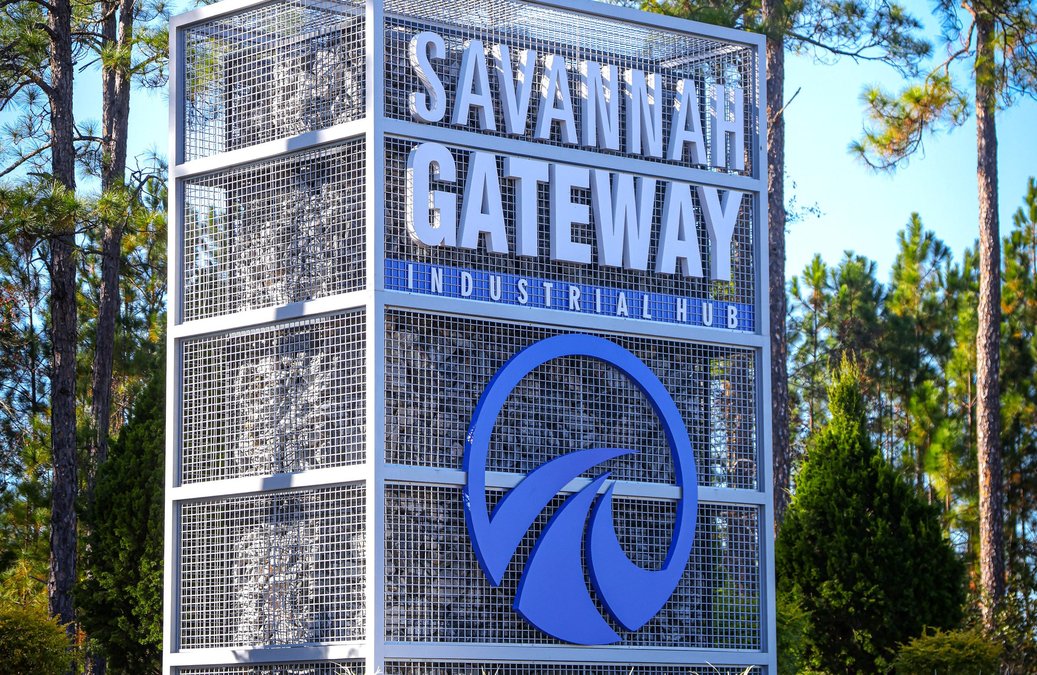
The proposed campus would be built within the Savannah Gateway Industrial Hub, one of the largest industrial developments in coastal Georgia.
This 2,600-acre tract of industrial-use land is part of a private-public partnership between the ECIDA and OmniTRAX, a North America-based short-line railroad operator and supply chain management company, under the Broe Real Estate Group. In 2016, the two entities signed a 75-year agreement, where the ECIDA provides the land and OmniTRAX is appointed as the exclusive master developer, managing infrastructure, marketing and land sales/leases to industrial “end users.”This agreement document was obtained by the Effingham Herald from the ECIDA.
While the land is still ECIDA-owned, Broe Real Estate maintains full control for the site’s development. However, the ECIDA is still able and expected to use “reasonable efforts” to provide “reasonable incentives” to end users, according to the agreement.
The agreement is intended to position the property as a major logistics and industrial center by taking advantage of its available acreage, transportation access and proximity to the Port of Savannah.
County and development officials have long marketed the site as one of the largest remaining industrial properties in coastal Georgia capable of accommodating major advanced manufacturing, logistics and technology projects.
The agreement doesn’t explicitly mention data center development. Potential uses of this property, as listed in the agreement, include: “warehouse, distribution, manufacturing and/or other industrial projects.” ECIDA officials noted that no amendments to the OmniTRAX agreement or additional approvals were needed by the ECIDA Board for the OpenAI project.