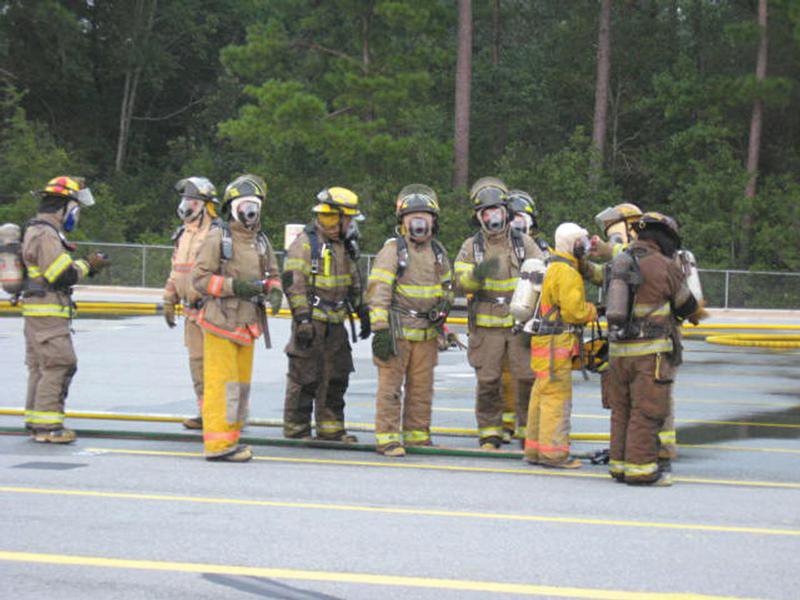
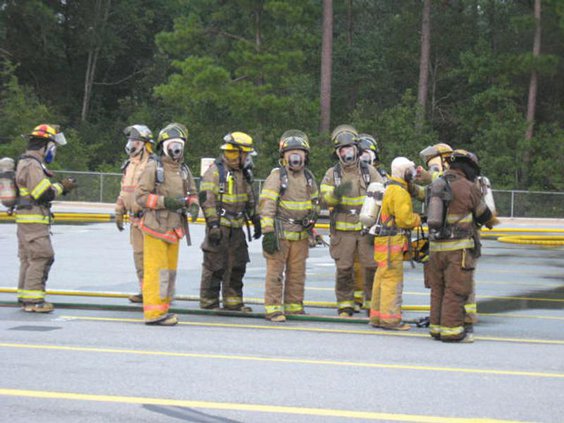
Firefighters from Effingham County and nine other departments took part in their annual pressurized container fire control class at South Effingham High School on Saturday.
The class was open to the public.
“That way the community can see where their money is being spent,” said Effingham County Fire Department Lt. Walter Wright.
After attending classes all afternoon beginning at 2 p.m. at the high school, volunteer and career firefighters gathered outside in the parking lot to practice putting out a burning liquefied petroleum gas container.
Prior to the demonstration, the crew tested the safety line and went through all the procedures. They began setting the container on fire once the sun went down.
“At night, you get the full effect of it (flames),” said Hannah Jenkins, Effingham County firefighter and public information officer.
The extremely flammable gas containers are found at homes and other structures supplied with natural gas service.
Wright noted that half of structure fires have an LPG on site. At the site of a house fire, the incident commander goes all around the home. He will note if there is an LPG tank present on the property. If so, he will instruct members of the firefighting crew to secure the container.
In the simulated class, firefighters first sprayed the burning LPG with a straight stream at 95 gallons a minute back and forth across the container to cool it off. After a few minutes of doing this, they slowly walked up to it, using a fog spray dial.
Wright explained that the fog spray is used to push the fire away from the firefighters.
Once the fire was out, a firefighter turned off the valve on the container to make sure further fires would not erupt.
The simulation was repeated multiple times and everyone was given a chance to do each task. Firefighters from Tybee Island, Richmond Hill, Bloomingdale, Bryan County, Rincon, Springfield, Newington, Pooler and Port Wentworth participated.
Wright explained that the various fire departments host training classes throughout the year, some of which are open to other departments to come and participate in. Effingham County hosted Saturday’s class.
Also on hand were the Bloomingdale Explorer Club and the Effingham County Venture Club. Both groups are made up of teens to young adults who are interested in firefighting.
Edward Zachary, 16, of the Explorers is a new member. He said he became interested in firefighting through his father, who is a firefighter with the Bloomingdale Fire Department.
Asked what he likes most about the profession, he answered, “Helping people.”
And least?
“Besides trying not to get burned …” he laughed it off.
Erica Strickland, 15, is an Explorer, too. She has over two years of volunteer fire department experience. There’s nothing she dislikes about the job and the “thrill” is what she most enjoys.
While Zachary is undecided on whether he will pursue firefighting as a career, Strickland definitely wants to become a firefighter. Her parents support her decision.
“They said it was a good idea,” she said.
Jenkins began her career as a volunteer while in high school, too. Some friends had volunteered with the department and she had to have some community service hours, so it was an easy decision.
“My first night, they put me on a hose line and I fell in love with it,” she recalled with a big smile.
Firefighting does not require any formal education, besides a high school diploma or GED. Volunteers can move right into the profession since the training is the same for both.
Still, it is not so easy to learn.
Firefighting today is not what it used to be, according to Wright. In the early years, most homes were made of wood and so firefighting only called for dumping water. Now, homes and other buildings contain all kinds of hazard materials and chemicals. Firefighters must know this information.
“It’s more technical now than it used to be,” he said.
Effingham County is in dire need of volunteer firefighters and support staff at the county and municipal level. Wright believes that time requirements deter a lot of people.
“That is a big killer to a lot of volunteers, I believe,” he said.
One of only two female firefighters with the county, Jenkins also sees the amount of time needed as one of the reasons why more women do not volunteer.
“It’s a physically demanding job,” she pointed out.
And Wright loves being able to help people.
“When others are running away, we’re coming in,” he said.
Nonetheless, for the men and women who fight fires the job is about more than altruism.
“A lot of us, it’s just something we love to do,” he added. “It gets in your blood.”