Effingham County leaders headed back from a retreat with a renewed commitment to working together, organizers said.
The annual Chamber of Commerce retreat on Jekyll Island wrapped up Friday morning as attendees finished their day and a half of discussions. Issues ranged from transportation to water and sewer to state House Speaker Glenn Richardson’s plan to overhaul the state’s tax system.
“I think this retreat brings to the forefront issues that are facing Effingham County,” Chamber President Freddy Long said. “It’s the only time all the entities are able to come together, and I’m glad the Chamber is able to do that and that’s the group that has to do it.”
From last year’s meeting, an ad hoc committee of school board, county, cities, development authority and industry officials was formed to go over the water and sewer challenges facing Effingham as a whole.
“I see the retreat bringing all the municipalities and county closer and closer together on the water and sewer issue,” Long said. “We’re coming closer and closer together. I really see that.”
Said Dr. Michael Moore, chairman of the water and sewer study committee, “I see some positive steps being made with communication and collaboration. And really, communication is the key. As long as people will talk to each other and share their input and knowledge, we can make inroads.”
The retreats have gotten people at least talking about the issues with each other.
“I think some of the hard lines have softened,” Moore, a former superintendent of schools and interim county administrator, said. “Are we where we need to be? No. But we are making progress.”
“The camaraderie that grows out of this, I don’t know where you can replace that,” Long said. “I don’t know where you get that anywhere else in Effingham County.”
Also as part of the retreat, representatives from the cities, county and other government entities gave updates on their respective authorities.
State Sen. Jack Hill (R-Reidsville) and state Rep. Jon Burns (R-Newington) laid out the issues the General Assembly is expected to take up when it convenes in January. Hill briefed the retreat on the plans for a truck route from the port of Savannah to I-95, a project that is estimated to cost $180 million and take five to seven years to build.
Hill also said the legislators likely will vote on the Georgia Water Council’s statewide water plan, but they could give it a yes or no vote and could not make recommendations and then vote on it. If lawmakers turn it down, they would have 20 days to fashion their own water plan.
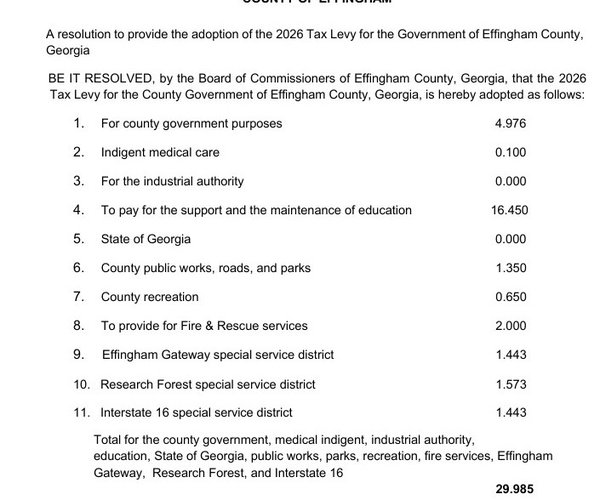
Alan Essig, executive director of the Georgia Budget and Policy Institute, and Nick Pearson, director of government affairs for the Georgia Chamber of Commerce, went over Speaker Richardson’s call to end property taxes in the state and instead rely on a mix of sales taxes and income taxes. Richardson’s bill, HB 900, has not been finished, so the details of the plan — and how to come up with nearly $9 billion that property taxes kick in to revenues — aren’t fleshed out.
While the possible end of property taxes was greeted warmly, there are several points to the plan that could be dangerous, Essig and Pearson pointed out. First, it could harm Georgia’s significant bond rating, which is based on the state’s use of varied and steady revenue streams. Second, it would mean the state would control all the tax revenues and then divvy it out to the cities and counties to use, putting a virtual end to local control.