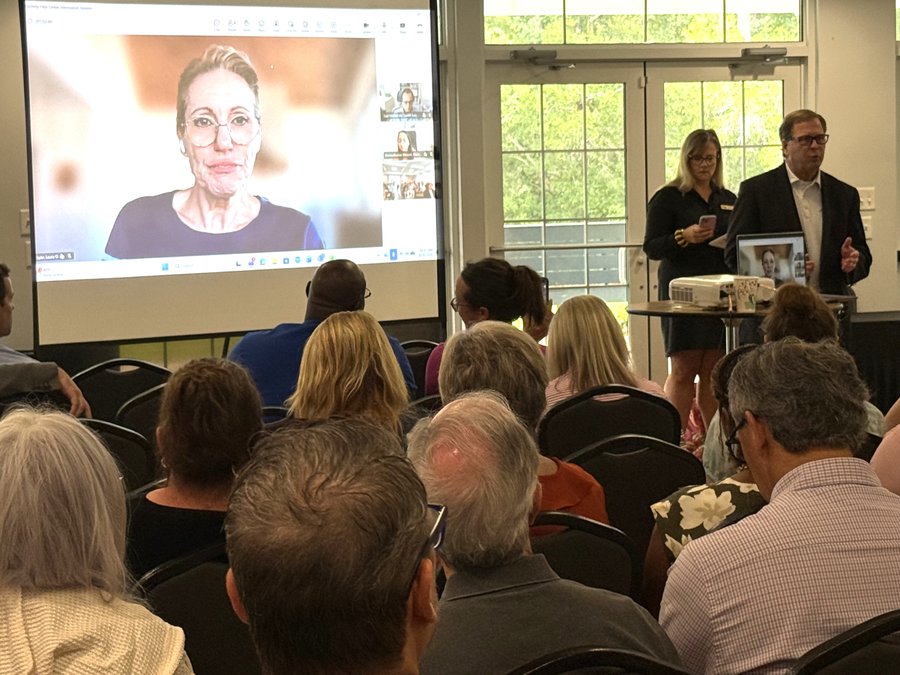
RINCON, Ga. — As Effingham County weighs the potential arrival of one of the largest AI data centers in the Southeast, Georgia Tech experts spent Wednesday answering questions about how the facilities work and what they could mean for the community.
How much electricity does an AI data center use? How much water does it need? How are the facilities cooled? What happens when the power goes out? And what can a community do about noise and lighting?
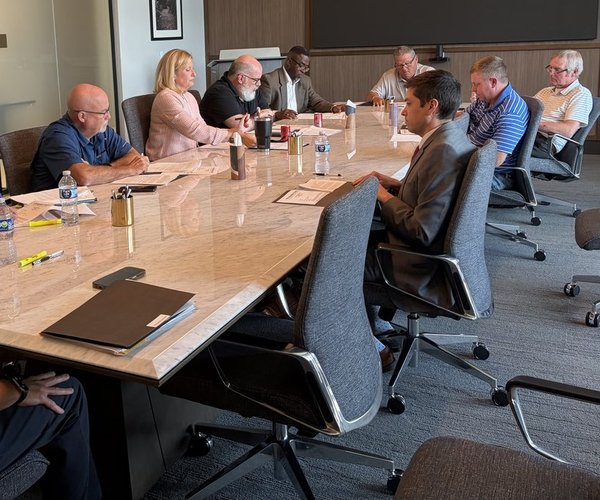
Those questions were the focus of morning and evening sessions organized by the Effingham County Chamber of Commerce and local officials at the Herald Center on Aug. 26. The panel included Georgia Tech professors specializing in economics, data science, energy policy, mechanical engineering and water-energy systems. Effingham County Commissioner Roger Burdette and Effingham County Industrial Development Authority CEO Brandt Herndon also participated. OpenAI was not represented.
The session was not a Project Camellia information session, Chamber President and CEO
Susan Kraut emphasized. Instead, it was designed to give residents a better understanding of modern data centers and provide information that could help the community evaluate projects such as the $20 billion AI campus proposed by OpenAI in Effingham County.
“We’re just here to answer questions and provide, again, data and research and sort of fact-based answers,” Betsy McGriff of Georgia Tech’s Enterprise Innovation Institute told the audience.
McGriff, who facilitated the discussion, also stressed that Georgia Tech was not taking a position on whether Effingham County should approve or oppose a data center.
“We don’t live here, and we don’t vote here, and we don’t pay taxes here,” she said. “So, what our role is is to really come in and inform and educate.”
Here are some of the major questions addressed during the session.
What makes an AI data center different?
The biggest difference is the computing equipment inside.
Ahmed Saeed, an assistant professor at Georgia Tech’s School of Computer Science who specializes in data science, said traditional data centers have grown substantially over the past two decades. But more efficient computer chips helped keep power and water use relatively stable.
That changed with the rise of artificial intelligence, he said.
AI systems require powerful graphics processing units, or GPUs. Large numbers of those chips can be packed into a single facility.
“What changed around 2021 is ChatGPT,” Saeed said, referring to the rapid growth of generative AI.
Unlike many of the chips used in traditional data centers, the chips used for AI computing require more power, he said.
Akanksha Menon, a Georgia Tech assistant professor of mechanical engineering who studies water, energy and cooling systems, said a single GPU can require roughly a kilowatt of power. When millions of those chips are packed into a facility, electricity demand can reach hundreds of megawatts or even gigawatts.
And virtually all of that electricity eventually becomes heat that must be removed, Menon said.
“They're actually more power hungry,” Saeed said of the newer AI-focused systems. “And with that, their footprint on communities where they're being built in terms of power consumption and water consumption is growing.”
How much power does a facility like Project Camellia need?
The planned power demand for Project Camellia is 3.2 gigawatts when the project is fully built in 2032, said Laura Taylor, a Georgia Tech economics professor and director of the university’s Energy Policy and Innovation Center.
To put that number in perspective, Taylor said 3.2 gigawatts is enough to power more than 2 million average homes.
But Project Camellia is part of a much larger increase in electricity demand expected across Georgia.
Georgia Power has announced contracts with 32 large customers, including data centers and industrial facilities, that together will require more than 15 gigawatts of additional power by 2031 and 2032, Taylor said.
Southern Company, which owns Georgia Power, also has identified another 75 gigawatts of potential demand from large customers across its service territory, she said.
“So, 3.2 gigawatts is a lot of power,” Taylor said, “but it’s part of a very large portfolio of power that is going to be delivered across Georgia. So, how are we going to meet the statewide increase in demand?”
Georgia is responding by adding more power generation, transmission lines and battery storage, Taylor said. Georgia Power plans to add natural-gas generation, solar and utility-scale battery storage. It also plans to upgrade existing transmission lines, build about 1,000 miles of new transmission and add substations.
Georgia Power also is entering into agreements with Alabama Power and Mississippi Power to bring electricity across state lines during periods of peak demand. All three utilities are owned by Southern Company.
In Effingham County, Georgia Power has announced a new substation and a new 500-kilovolt transmission line to serve Project Camellia. Taylor said she was not aware of the locations of those facilities.
Georgia Power also has announced a new natural-gas turbine at Plant McIntosh in Effingham County. The new unit is expected to generate about 800 megawatts of electricity — just under 1 gigawatt.
Project Camellia would require about four times as much power as the new Plant McIntosh turbine is expected to generate.
Can the power grid handle the demand?
The panel said the grid is being expanded to meet the growing demand.
One way to ease the strain is for large customers to reduce their electricity use when demand is highest.
Taylor said OpenAI has agreed to provide up to 1 gigawatt of demand response, meaning Georgia Power could ask the company to reduce its electricity use during periods of peak demand.
“So think of that peak afternoon and air conditionings are running 100 percent, and it's humid and so forth,” Taylor said. “Georgia Power can call on OpenAI to power down up to a whole gigawatt, so about a third of its power demand. That's actually a new innovation in contracting with data centers.”
Who pays for the additional electricity infrastructure?
Taylor said regular Georgia Power customers generally will not have to pay for infrastructure built specifically to serve large electricity users such as data centers.
The Georgia Public Service Commission established new requirements in 2025 for Georgia Power customers that use more than 100 megawatts of electricity. Those customers must pay for the new generation, transmission lines and substations needed to serve them.
Long-term contracts, minimum bills, collateral requirements and early-termination provisions also help protect Georgia Power if a large customer does not build as promised.
Taylor emphasized that the rules apply to Georgia Power, which is regulated by the Public Service Commission.
What happens if the power goes out?
A data center the size of Project Camellia needs backup power to keep its equipment running if the electricity from the grid goes out.
Saeed said diesel generators are the most common form of backup power for data centers. Natural-gas turbines also can be used, while fuel cells and large battery systems are becoming more common.
But backup systems can create their own concerns for communities, particularly when diesel generators are used, he said.
“One of the main sources of concern with data centers when they're coming into a community” is the use of diesel generators, Saeed said. If those generators are used beyond their intended backup role, they can have a greater impact on surrounding communities through air pollution and noise, he said.
Menon said fuel cells generate electricity through an electrochemical reaction rather than combustion. Large batteries also can provide backup power, but they generally are better suited for short-term use and may not be practical as the only backup source for a facility requiring hundreds of megawatts.
The experts said they do not know what type of backup power Project Camellia will use or how much backup capacity it will have. Those decisions will be made as the facility is designed.
How much water does an AI data center use?
Menon said there is no simple answer to how much water an AI data center uses because it depends largely on how the facility is cooled.
AI chips generate enormous amounts of heat, and that heat has to be removed to keep the equipment running, she said.
Menon described three basic ways data centers can be cooled.
Traditional cooling towers use evaporation to remove heat. Roughly 80% of the water used in evaporative cooling can be lost through evaporation, she said. The remaining water, known as blowdown, must be treated or reused.
Dry cooling uses fans and heat exchangers instead of evaporating large amounts of water. It uses much less water but can require more electricity, Menon said.
Chillers are another option, she said. They work somewhat like large air conditioners and can provide colder temperatures, but they also require more electricity.
The final cooling system is an engineering decision for each facility, she said.
Menon also stressed that water used for bathrooms, kitchens and other routine operations is much smaller than the amount of water used for cooling.
And there is another water question, she said: How much water is used to produce the electricity that powers the data center?
Power generation can require water, depending on how the electricity is produced. That water use occurs away from the data center and depends on the utility's mix of power sources, Menon said.
What about noise?
Noise is one of the issues communities can address through local data center ordinances. Taylor said Georgia Tech has reviewed 26 data center ordinances in Georgia through its Data Center Ordinance Hub.
Most ordinances set limits for noise at the property line of a data center, Taylor said. They also typically set different limits for daytime and nighttime.
Taylor said the most common limits in Georgia are 65 decibels during the day and 55 decibels at night. The daytime limit is roughly the level of a normal conversation between two people standing a few feet apart. A 55-decibel level is considered moderate background noise.
Some communities have taken a different approach. Taylor cited Coweta County, which requires a noise study before construction and limits a data center to adding no more than five decibels to existing noise levels.
Effingham County Manager Tim Callanan, speaking during the evening session, said some of the common noise concerns associated with data centers will be mitigated at Project Camellia.
“Effingham County has the strongest buffers with regards to industrial around,” he said.
Callanan said OpenAI has indicated it will use vegetative berms as buffers and follow the county’s heavy-industrial buffer requirements.
“There’s going to be some voluntary things that are done that are above and beyond what the county requires,” he said.
Callanan said OpenAI also will be required to submit a noise study to the county before construction.
“That’s going to create a baseline of the existing noise characteristics at the property,” he said. “Then they’re going to review the equipment that they’re actually putting on, and its noise characteristics.”
Backup generators also can be regulated, including restrictions on when they can be tested. Callanan said OpenAI plans to use a battery storage backup system rather than diesel generators on site.
Taylor said communities are also paying more attention to low-frequency noise, which can be harder to measure with traditional noise standards.
Some jurisdictions are considering different types of noise measurements to better capture those lower frequencies. Taylor said acoustic engineers would be better equipped to address the technical questions surrounding low-frequency noise.
What about nighttime lighting?
Communities also can use local ordinances to limit light from data centers, Taylor said.
Many use dark-sky principles, requiring lights to be shielded and directed downward so they don't shine beyond the property. Some communities also measure light at the property line and set specific limits.
“Some places like Adairsville and Coweta County again, they require measurement of light at the property boundary, and it has to be at nighttime,” Taylor said. “It has to be below a specific threshold, like 0.05 candles, which is 5% of the light that a candle would put off. So very, very faint.”
Restrictions also can address the height of light poles and glare from the facility.
What does the community gain?
Taylor said a major industrial project can bring jobs, investment, economic activity and tax revenue to a community.
But she cautioned against viewing the decision simply as a choice between building a data center and doing nothing.
Instead, she said, the county should consider what the data center would bring compared with what could be built on the property if the project does not move forward.
That question is particularly relevant to the Effingham property where Project Camellia has been proposed.
Herndon said the property has been designated for industrial development for years and was being developed as part of the Savannah Gateway Industrial Hub.
Without the data center, he said, the property likely would have continued toward logistics, warehousing and potentially trucking-related development.
How would Effingham regulate and monitor a data center?
Commissioner Burdette said county officials are considering additional local requirements involving noise, water, energy and other potential impacts.
One idea is to take baseline measurements before construction begins. That would give the county a record of existing conditions to compare with conditions after the data center is built.
For noise, for example, the county could document existing noise levels and then continue monitoring after construction to determine whether the facility is exceeding local limits.
Burdette also raised the possibility of installing permanent monitoring stations and creating a public dashboard so residents could see the data.
He said the county also is considering hiring an independent firm with expertise in data centers and engineering to help monitor the project.
The goal, he said, would be to give the county independent information throughout construction and operation.
What questions remain unanswered?
Not every question about Project Camellia can be answered yet, the panelists said.
The Georgia Tech experts did not have OpenAI's detailed engineering plans, so questions about cooling, water use and backup power remain unanswered.
Health effects associated with data-center noise, particularly low-frequency noise, also remain an emerging area of research.
McGriff said additional Georgia Tech experts and researchers could join future discussions as more information becomes available. Burdette said the county also could invite OpenAI representatives to participate.
Burdette said the county intends to continue holding information sessions and giving residents additional opportunities to ask questions.
“We're going to keep answering those questions,” he said.