ATLANTA – Georgia Power’s contract with OpenAI was approved and the final Development of Regional Impact report for the Effingham County data center was released Aug. 26. So, what’s next?
These updates mark separate steps in the process for the 1,400-acre data center project.
The Georgia Power contract, approved by the Georgia Public Service Commission (PSC), secures delivery of 3,200 megawatts of electricity to the data center campus. The Coastal Regional Commission (CRC) of Georgia’s final DRI report analyzes the project’s potential impacts on traffic, the environment and public services and offers recommendations to mitigate them.
“The Georgia Power contract, that process with the PSC happens independent of the county’s process,” Effingham County Manager Tim Callanan said. “The thing that the county has been waiting on … was the final report on the DRI application.”
He said the report was the county’s final requirement before it can approve Project Camellia’s preliminary site plan.
Effingham County’s next steps
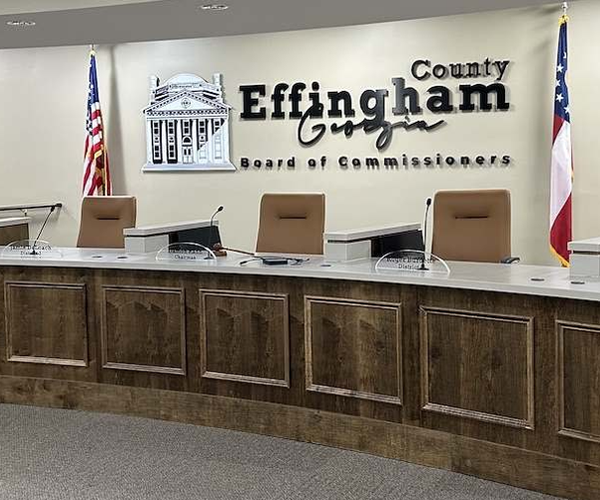
The county will discuss the project this weekend. The Effingham County Board of Commissioners will hold a three-hour public work session on Saturday, Aug. 29, from 10 a.m. to 1 p.m. at the county’s administrative complex, 804 S. Laurel St. in Springfield.
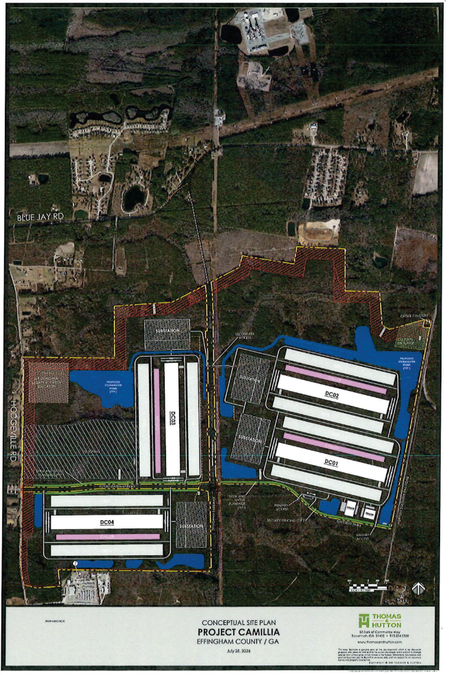
Callanan said the next step is a preliminary site plan review, which will give commissioners an initial look at the proposed layout and whether it meets requirements such as buffers and setbacks.
A more detailed development plan review will follow, with review of wetlands regulations, stormwater requirements, land-disturbance permits and other applicable laws.
Callanan said he anticipates the Effingham County Board of Commissioners will review the preliminary site plan Sept. 14.
The final DRI identified environmental concerns involving wetlands, floodplains, stormwater, wildlife and water quality.
About 65% of the project site is expected to be covered by buildings, pavement and other surfaces that prevent rainwater from soaking into the ground at full buildout. Savannah Riverkeeper said that could substantially increase stormwater runoff and the potential for pollutants and debris to reach surrounding waterways.
The CRC advised the county to evaluate potential impacts on the drainage system and flood risks associated with the development, including FEMA flood-zone designations.
What’s next for Georgia Power?
Georgia Power Communications Lead Joshua Peacock said Project Camellia remains in its early stages despite the contract approval.
“Building substations, building transmission lines, infrastructure, it takes a while to do that,” Peacock said. “It’s a detailed planning process that we have to go through.”
As both Project Camellia and the transmission line project move forward, Peacock said, updates and timelines will be posted at Georgia Power’s site.
A landmark agreement
At 3.2 gigawatts at full buildout, the campus will require enough electricity to power roughly three Atlanta-sized cities, making OpenAI one of Georgia Power’s largest individual customers.
Georgia Power previously sought approval from the Public Service Commission to expand its generation capacity by 9,900 megawatts, citing growth from large energy users across Georgia, primarily data centers.
Peacock said the utility has the capacity to serve the Effingham facility as well as other large customers expected to come online. The state’s electric grid is interconnected with neighboring states, allowing utilities to buy and sell power across the Southeast.
Georgia Power is also awaiting state permits to expand two natural gas plants to support energy needs, including Effingham County’s Plant McIntosh.
Georgia Power claims its growing portfolio of large-load customers will deliver about $950 million in annual savings to utility customers – about $180 per year – beginning in 2029.
“We know every dollar counts, and we know that in many parts of the country growth is pushing electric rates up. That is not happening in Georgia,” Georgia Power Chairman, President and CEO Kim Greene said in a statement. “In December, we committed to $102 a year in savings for the typical family beginning in 2029. Today, that number is expected to be $180.”
Under the agreement, OpenAI will pay the full cost of the infrastructure required to serve its project.
Hubbard says OpenAI contract deserved more scrutiny
The contract between Georgia Power and OpenAI has been “entirely redacted” from public view due to “trade secrets.”
Peacock said this is standard with how the utility operates.
“We don’t share customer information, whether that’s a residential customer or a commercial customer,” he said. “There’s private information in that contract that helps our customer remain competitive but also helps our business remain competitive. If that information was shared, that would hurt our competitiveness in the process and then eventually hurt ratepayers.”
Still, Peacock called the PSC’s regulatory process “very transparent.”
During an Aug. 13 public hearing, PSC Commissioner Peter Hubbard pushed for more transparency. The contract review period was then extended to Aug. 26. Still, Hubbard said he believes the contract didn’t receive the scrutiny it deserved.
“It’s 32 times the size of the threshold of contracts that are considered ‘large-load,’” Hubbard said. “I just feel that something of this magnitude does deserve special scrutiny.”
Hubbard said his review of the contract focused largely on the financial risks associated with serving a massive new customer.
He said among the questions he considers when reviewing a large-load contract are whether the customer has provided enough collateral to cover Georgia Power’s costs if the project is terminated early, how power-generation resources built for the customer could be reassigned, and whether minimum monthly payments adequately cover the cost of service.
Hubbard said he sought to improve the contract with additional protections, particularly provisions intended to ensure that costs associated with serving data centers are not shifted to residential customers and small businesses.
“It’s almost like a promissory note that also needs to be enforced down the road,” Hubbard said. “It’s helpful to have that improved language that none of the costs will be shifted onto the backs of utility payers and small businesses from these data centers, and the infrastructure we’re building for them, but it has to be enforced by a commission that is willing to enforce it.”
Hubbard said OpenAI’s agreement to include up to 1,000 megawatts of flexible demand response was a positive contract feature. It’s the first time a Georgia Power customer has made this type of agreement.
That provision would allow Georgia Power, at its discretion, to reduce electricity delivered to the facility during periods when the grid is under stress. The utility says the arrangement could reduce the amount of additional generation capacity it needs to build and allow the resulting benefits to be spread across its customer base.
“That’s a good thing that should be incorporated in frankly every contract for electric service for a data center,” Hubbard said.
Amid the contract review process, the PSC also elected to hold its Sept. 15 meeting outside of Atlanta. Its administrative session will be held from 9:30 a.m. until noon at the Chatham County Administrative Building, 124 Bull St. in Savannah. At the forum, Georgians will have the opportunity to address the PSC with comments or concerns.