RINCON, Ga. — Rincon homeowners will soon receive something they haven’t received from the city in nearly 30 years: a property tax bill.
The Rincon City Council voted unanimously Aug. 24 to adopt a 2.323-mill property tax rate, replacing the $240 annual fee property owners have been paying through their water bills.
The change gives Rincon a more predictable source of revenue as the city grows. It also could allow the city to take part in a new property tax relief program if voters approve it in November.
The council’s vote followed three public hearings on the proposed millage rate, beginning the process of ending Rincon’s zero municipal property tax rate, which has been in place since 1998.
During the public hearing process, Mayor Kevin Exley said the city’s current system made sense when Rincon was much smaller. It makes less sense now.
Rincon had about 3,057 residents in 1998. Today, the city has about 13,000.
That growth has brought more demand for police, fire protection, roads, parks and other city services. Rincon also serves as an urban center for the county, with an estimated 35,000 to 40,000 people passing through the city each day.
The new property tax will replace the $240 fee, rather than add another source of revenue on top of it.
“We’re going to get the millage set to match that fee,” Exley said.
But how much individual property owners pay will change.
Under the old system, every property owner paid the same $240 annual fee, regardless of the property’s value. Under the new system, the tax will be based on the taxable value of the property.
That means some homeowners will pay less than they did under the fee. Others will pay more.
It also means Rincon’s large commercial properties will pay considerably more than they did under the flat-fee system.
Councilman Jesse “Ben” Blackwell emphasized that the new tax will apply to businesses as well as homeowners.
“I just want to reiterate what we said in the workshops and previous council meetings: This is a tax for all of Rincon, not just homeowners,” Blackwell said before the vote. “That means every business out here.”
Under the current system, Blackwell said, homeowners and businesses pay the same $240 annual fee.
“Right now, homeowners are paying $240 for these structured fees that we’re changing to a millage rate. But so is Walmart, Kmart, Kroger, Lowe’s, Tractor Supply and all these other businesses,” he said.
That will change significantly for commercial properties, he said, because their values are much higher than the average $300,000 home used in the city’s calculations.
“Think of Walmart. That building out there is probably in the $5 million to $10 million range,” Blackwell said. “So their tax will be significantly higher at 2.323 mills. The tax base will level out to where it needs to be.”
Blackwell said the change will produce a different result for homeowners.
“Some homeowners are going to pay less, and some are going to pay a little more — not much more,” he said.
Why change now?
City leaders gave several reasons for moving from a flat fee to a property tax.
A property tax provides a more stable source of revenue as Rincon grows. It also spreads the cost of city services based on property values rather than charging every property owner the same amount.
And there is another reason that has become especially important: LHOST.
The Local Homeowners Incentive Adjustment Grant is a new program authorized by the Georgia General Assembly that could allow local governments to use surplus revenue or excess fund balance to provide property tax credits to qualifying homesteaded residences.
Effingham County commissioners voted July 28 to put the creation of the program before voters.
The program is part of the county’s broader Project Zero initiative, which aims to eliminate the county government’s share of property taxes on qualifying homesteaded properties.
Rincon, however, did not have a municipal property tax.
Exley said that created a problem if LHOST passes.
The city would have no municipal property tax to offset unless it first established a millage rate.
If voters approve LHOST and Rincon’s new millage rate remains in place, Exley said qualifying homeowners could potentially have their city property taxes covered through the program.
That could mean homeowners receive tax relief while commercial properties continue paying into the city’s tax base.
“If LHOST passes, and I hope it does, for the first time in forever, LHOST will come over and it will pay our homestead taxes,” Exley said.
Exley also encouraged residents who qualify for a homestead exemption to make sure they have filed for one.
What will you pay?
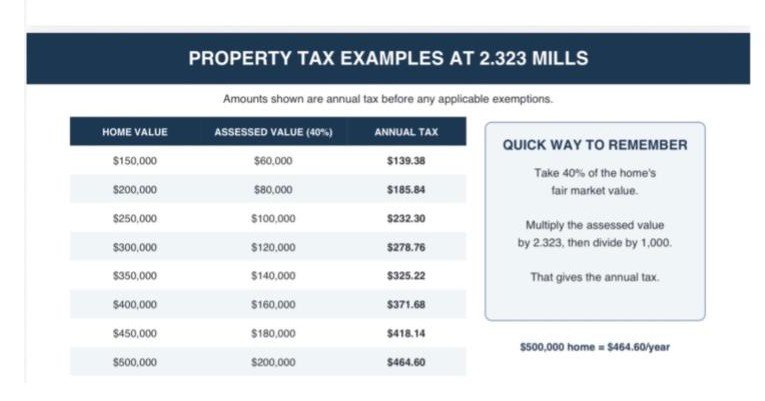
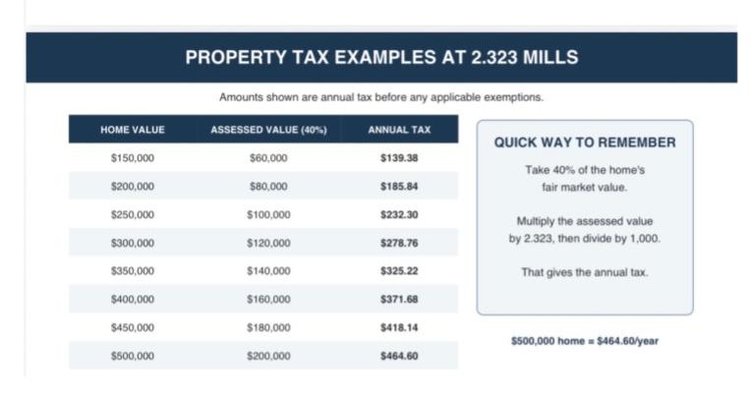
The 2.323-mill rate does not mean a homeowner will pay 2.323% of the value of the house.
Georgia property taxes are based on 40% of a property’s fair market value.
City officials used a $300,000 home as the median property value for their calculations.
For a $300,000 home:
- Fair market value: $300,000
- Assessed value: $120,000
- City property tax: about $278
- Former annual fee: $240
- Difference: about $38
The difference will depend on the value of each property.
A $200,000 home, for example, would have an assessed value of $80,000 and generate about $186 in city property taxes — less than the former $240 fee.
The 2.323-mill rate was designed to replace the revenue generated by the $240 fee.