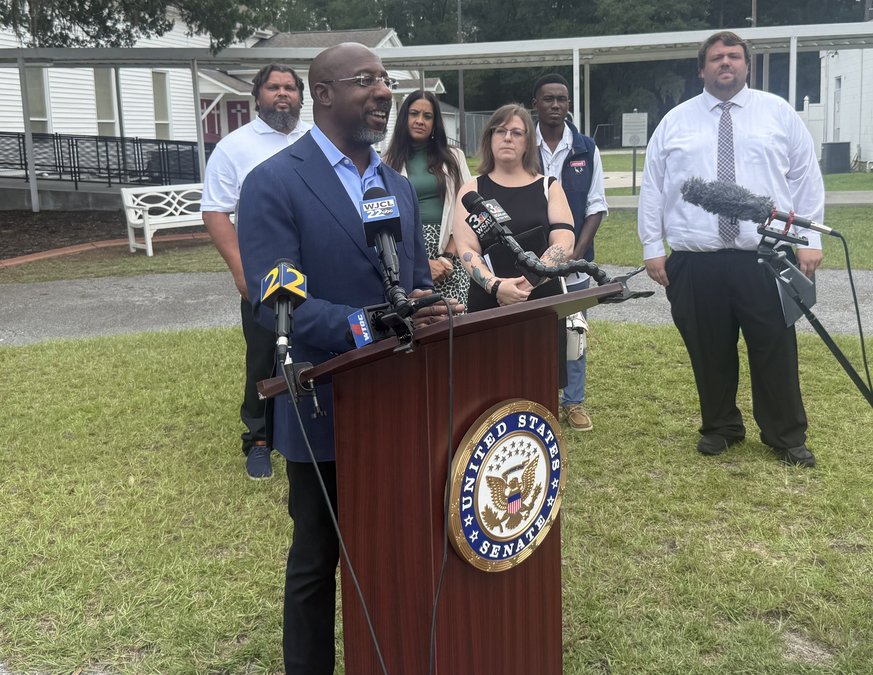
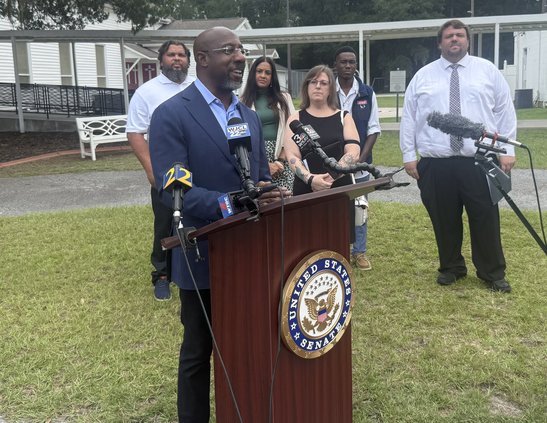
GUYTON, Ga. — U.S. Sen. Raphael Warnock, D-Ga., came home to coastal Georgia Friday to visit the proposed site of OpenAI’s $20 billion Project Camellia in Effingham County — and called for a moratorium on data center development until residents have a meaningful voice in whether such projects are built in their communities.
Warnock, who grew up in nearby Savannah and has family ties to Effingham County, also said data centers should not be allowed to move forward unless developers can guarantee they will not drive up residents’ water or electric bills, pollute the air or water, create unresolved noise and light problems, or make deals behind closed doors.
“Only when a data center developer can make guarantees on utility rates, on pollution, and transparency should they be allowed to build,” Warnock said.
His visit comes as opposition to Project Camellia has grown among many Effingham residents who say they were left out of the process that led to the project. The proposed 1,400-acre campus in the Savannah Gateway Industrial Hub will require 3.2 gigawatts - enough electricity to power roughly three Atlanta-sized cities, making it one of the largest data centers in the Southeast.
Warnock said he is not opposed to artificial intelligence or data centers. He is opposed to communities being asked to accept multibillion-dollar developments without having a meaningful voice in the process.
“This is not OpenAI County. This is Effingham County,” Warnock said.
Warnock also made clear that he does not believe Project Camellia is a done deal.
“It’s not impossible,” he said when asked whether there is a path to stop the project.
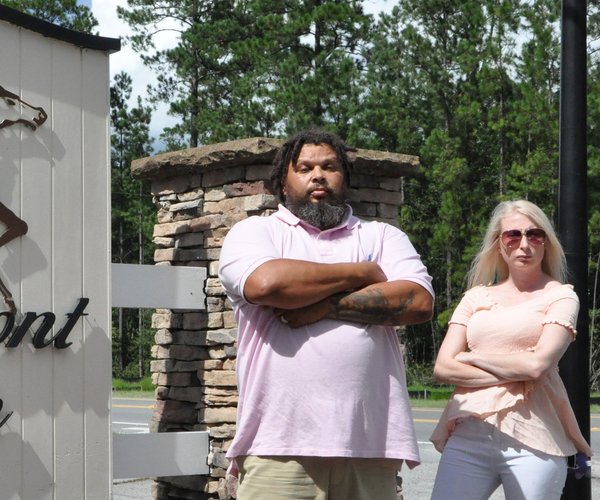
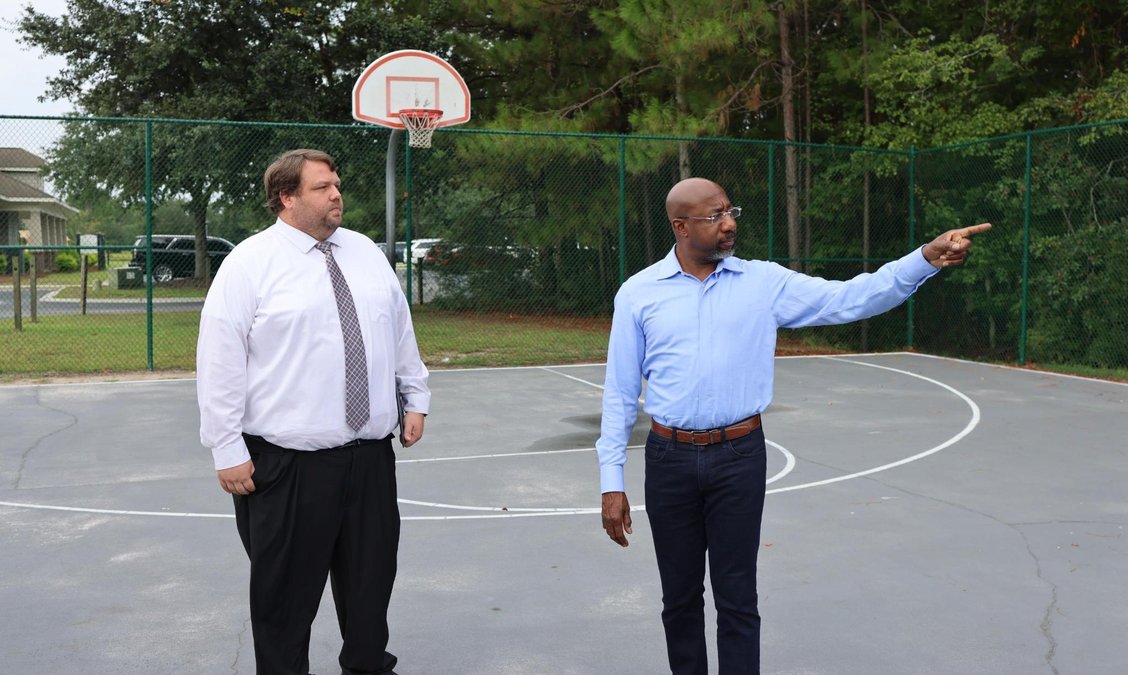
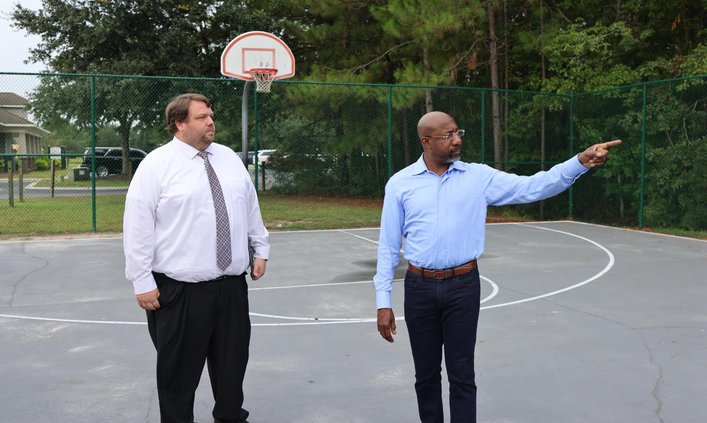
Warnock began his visit by meeting privately with John Smith, chairman of Protect Effingham Alliance, whose home in Belmont Glen is about 1,000 yards from the proposed data center site. Warnock toured the neighborhood with Smith before the two went to Zion Lutheran Church in Guyton for a private meeting with community stakeholders.
Carrie Weber, a concerned community member who volunteers with Protect Effingham Alliance, said Warnock used the private meeting as an informal roundtable with residents and other community stakeholders.
“He was trying to get the opinions of the people who were going to be the most affected,” Weber, who was in the meeting, said.
Weber said Warnock also wanted to know how residents first learned about Project Camellia and whether they had been able to speak directly with OpenAI or county commissioners.
“A select few have, but overall, no,” she said. “We were kept in the dark.”
Warnock and Smith later addressed reporters outside the church.
‘You can’t really advocate for people without talking to people’
Warnock said he came to Effingham because residents had been asking questions about Project Camellia and he wanted to hear those concerns firsthand.
“You can’t really advocate for people without talking to people,” Warnock said.
He said his tour of Belmont Glen gave him a better understanding of the concerns facing residents living near the proposed site, including questions about noise, pollution and utility costs.
The proposed development also would be located near Blandford Elementary School, a point Warnock said stood out during his visit.
“I’m struck by the location,” he said. “It’s right near an elementary school.”
But Warnock said the location itself is not the central issue.
“It’s not really what I think. It’s about what the people in this county think, and that’s what went wrong here,” he said. “They never got a chance to even raise the question, let alone get to the right answer.”
Warnock said he was particularly critical of the lack of public input before the project was announced.
“How do you bring a multibillion-dollar site to a community and not have a single community hearing?” he said.
He said the process has created distrust among residents.
“I’m deeply concerned about the process by which this major decision was handed down to the Effingham community,” Warnock said.
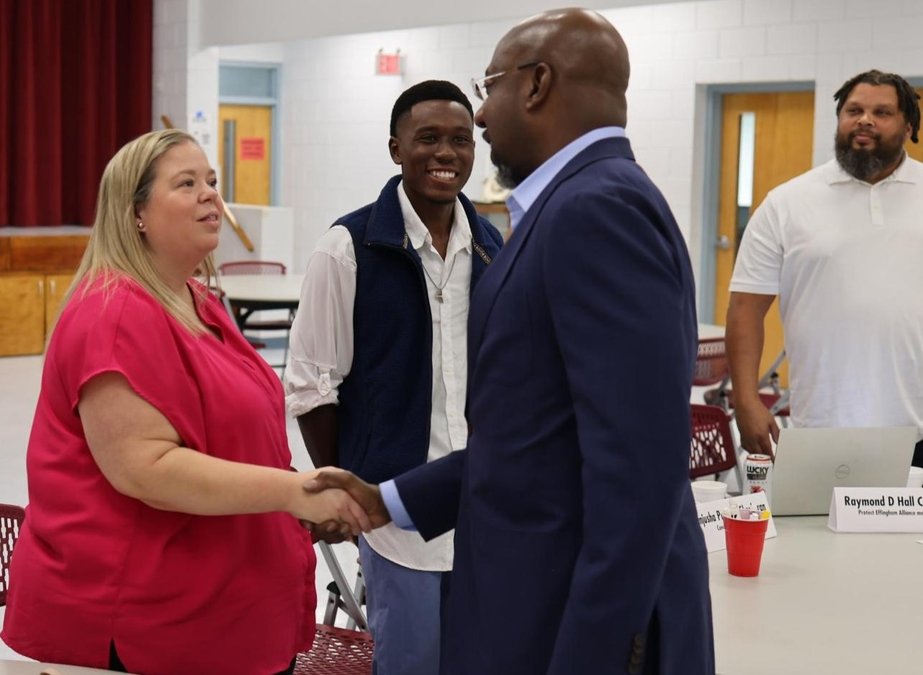
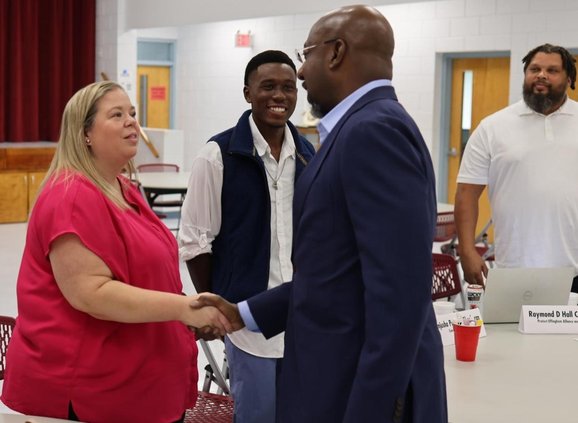
Warnock says Project Camellia is not inevitable
Warnock rejected the idea that Project Camellia is now inevitable.
“It’s not impossible,” he said when asked whether there is a path to stop the project.
He said the rapid expansion of artificial intelligence has moved faster than government regulation, leaving local communities with fewer tools when negotiating with multibillion-dollar corporations.
“What you’re witnessing is the real-life consequences of a feckless Congress,” Warnock said.
He said Congress has failed to establish adequate guardrails as data centers expand across the country.
“Local communities and states find themselves in a race to the bottom while negotiating with multibillion-dollar corporations,” he said.
Warnock also criticized the use of nondisclosure agreements in data center negotiations and said residents should not be expected to trust a deal they cannot fully examine.
“These NDAs are the opposite of democracy,” he said.
He said it is not too late for OpenAI to explain Project Camellia publicly.
“If it’s so good, they should lay it out before the community,” Warnock said. “And it’s not too late for that to happen. It is late, but it should still happen.”
OpenAI, in a statement provided to the Herald, said the company supports Warnock’s focus on protecting Georgia families and local communities.
We support Senator Warnock’s focus on protecting Georgia families and local communities. That is why OpenAI will pay the full cost of the electric infrastructure and service required for Project Camellia, use closed-loop cooling designed to keep ongoing water use low, and provide $80 million in community benefits shaped by local input.
“Since announcing the project, we have been meeting with residents, local organizations, elected officials, and other stakeholders to share information and hear their perspectives. We will continue that engagement as the project moves through design, permitting, and review.”
Smith calls for immediate moratorium
Smith echoed Warnock’s call for a moratorium and said residents need a greater role in decisions involving large-scale development.
“When I first found out about this project, I was confused,” Smith said. “Why was I being informed by our school system?”
Smith questioned why residents were not involved before the project was finalized.
“Why wasn’t this a conversation before it became a done deal?” he said. “Why weren’t we putting guardrails in place before the deal was signed?”
Smith urged residents to attend Saturday’s county work session and participate in the ongoing debate over Project Camellia.
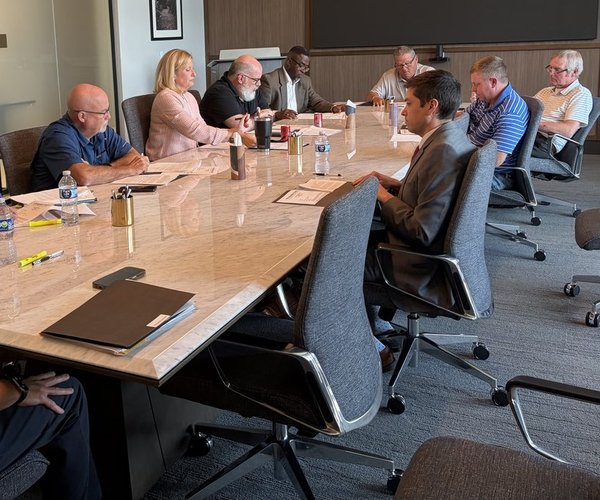
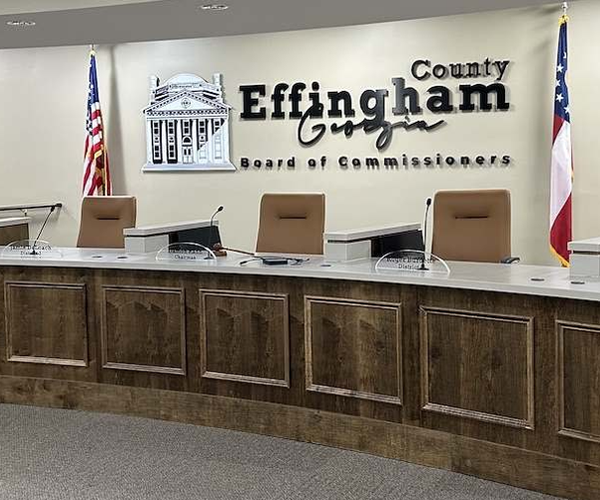
The Effingham County Board of Commissioners will hold a three-hour public work session Saturday, Aug. 29, from 10 a.m. to 1 p.m. at the county’s administrative complex, 804 S. Laurel St. in Springfield.
“At the end of the day, this proposed project would impact all of the residents in Effingham County and the surrounding area,” Smith said.
‘What I’m opposed to is no transparency’
Warnock said his concerns extend beyond Project Camellia.
“This problem, however, is not unique to OpenAI,” he said. “Data center developers across the country are not operating in partnership with communities.”
He said he is not opposed to the technology itself.
“Artificial intelligence is a part of our daily lives,” Warnock said. “What I’m opposed to is no transparency.”
Warnock also was asked about the agreement between Georgia Power and OpenAI that would make OpenAI the largest single power customer in state history.
He said the agreement does not eliminate the need for public scrutiny.
“If you got a good deal, you don’t hide it,” Warnock said. “If this is a great deal, tell the story. Don’t hide.”
Warnock said he plans to remain involved in the issue and continue returning to Effingham County.
“I’m going to stay engaged with this issue, and I’m going to keep showing up over and over again for the people of Effingham County,” he said.